Depleted uranium has been used in the military industry for decades because of its high density. Its use in several recent armed conflicts has raised questions about its health and environmental effects. This article presents its properties, the current state of scientific knowledge on its toxicity, and its current legal status.
1. What is depleted uranium? Origin and Physicochemical properties
Depleted uranium is a by-product of uranium enrichment plants, which convert natural uranium into fuel for nuclear power stations, or of spent fuel reprocessing facilities. Although depleted uranium is less radioactive than natural uranium, its chemical properties—and in particular its chemical toxicity—remain the same.
Depleted uranium has a very high density, greater than that of lead, which makes it a highly sought-after material for applications requiring significant weight within a small volume. In civilian industry, it is used, for example, to ballast the keels of racing yachts. It is used above all by the military in armor-piercing munitions. These munitions are generally fired from tanks and other armored vehicles or from aircraft, and are aimed at armored targets. Tanks fire larger-caliber rounds (105–125 mm), while aircraft, troop transports, and infantry fighting vehicles use smaller-caliber rounds (20–30 mm).
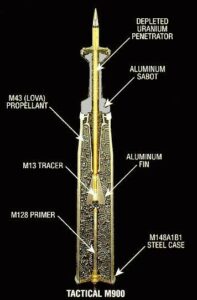
Most depleted uranium munitions are simply solid depleted uranium projectiles. However, large-caliber depleted uranium tank rounds generally consist of a depleted uranium rod (the penetrator) housed inside an aluminum “sabot” (or sleeve) and a steel casing (see figure below). When fired, the sabot and casing are ejected, leaving the depleted uranium penetrator to travel toward the intended target, much like smaller-caliber bullets.
2. Chemical and radiological toxicity of depleted uranium
The risks associated with external exposure to depleted uranium are negligible, since it is only weakly radioactive—40% less radioactive than the uranium found in the natural environment—and therefore adds very little to existing levels of ionizing radiation in the environment. However, military personnel who handle depleted uranium munitions over extended periods may face a higher risk.
In addition, on impact, depleted uranium munitions or bombs shatter and ignite, releasing fine dust particles of the metal and its oxides into the atmosphere as aerosols. Easily carried by the wind, these particles can settle several kilometers from the point of impact and contaminate soil, water, and the food chain. The main risks to human health then come from these depleted uranium particles or dust, which can enter the body through inhalation, ingestion, or an open wound. The level of risk is determined by the route of exposure, the level of exposure, and the characteristics of the material (for example, particle size).
If depleted uranium enters the body in sufficient quantities, it can cause kidney damage due to its chemical toxicity, and inhaled particles can also damage the respiratory system.
3. Gulf war and Balkans syndromes
Depleted uranium munitions have thus been suspected of causing “Gulf War syndrome” and later “Balkans syndrome,” which affected military personnel who took part in these conflicts. They reported suffering from fatigue, and pulmonary, intestinal, and cardiac illnesses, and some reported cases of leukemia. The role of depleted uranium in these ailments remains controversial.
Scientific studies conducted by the World Health Organization (WHO) and the United Nations Environment Programme (UNEP) in the early 2000s found no significant health risks for military personnel and civilians associated with the residues of depleted uranium munitions. These studies have, however, themselves been criticized for lacking precision and being inadequate. For example, the international radiation protection standards used as a reference deal only with external radiation exposure.
Although all the public bodies concerned continue to maintain that there is no evidence that the effects of these munitions are significantly harmful to any operational forces or civilians, the U.S. military has acknowledged that depleted uranium can pose hazards.
4. Environmental contamination and civilian exposure
Also due to the lack of relevant studies on the subject, soil contamination has not been proven either. However, surveys conducted in 2003 in regions of Afghanistan where these munitions were reportedly used showed concentrations of depleted uranium particles in water and soil exceeding the thresholds accepted by the WHO. It is also established that uranium migrates through soil and can, over the longer term, reach groundwater tables.
On the civilian side, an observation similar to that made among military personnel was recorded in Fallujah, Iraq. The city was the site of massive depleted uranium munitions strikes and remained, moreover, littered with debris that was sometimes handled by the local population. A sharp increase was recorded in the number of children presenting symptoms such as hair loss and kidney disorders, as well as people affected by leukemia and other cancers. Here again, no causal link has been established.
5. International legal status: A weapon that is not banned
Although the toxicity of depleted uranium munitions is now strongly suspected, this type of weapon is not banned by any international convention. Depleted uranium munitions continue to be classified as conventional weapons rather than as nuclear, radiological, or chemical weapons.
These munitions do not fall under the Rome Statute of the International Criminal Court, which prohibits weapons that have been deliberately rendered toxic or whose purpose is to poison people. It therefore does not constitute an appropriate framework for imposing a ban on depleted uranium munitions.
Customary international humanitarian law requires that all means and methods of warfare, including depleted uranium munitions, be used with due regard for the protection and preservation of the natural environment. In the conduct of military operations, all feasible precautions must be taken to avoid, and in any event to minimize, incidental damage to the environment. The absence of scientific certainty regarding the environmental effects of certain military operations, including the use of depleted uranium munitions, does not exempt a party to a conflict from taking such precautions.
In 2008, the European Parliament adopted a resolution [7] stating that “the use of depleted uranium in conflicts violates the fundamental rules and principles enshrined in international humanitarian and environmental law” and that “even though there is as yet no undisputed scientific proof of its harmfulness, there are many accounts of harmful, and often fatal, effects on both military personnel and civilians.” Although not legally binding, the resolution reflects members’ determination to secure recognition of the toxicity of these munitions and to obtain their prohibition.
The use of depleted uranium in conflicts violates the fundamental rules and principles enshrined in international humanitarian and environmental law.
6. Frequently Asked Questions
Why is depleted uranium used in military ammunition?
Depleted uranium is prized for its very high density, greater than lead, which lets it deliver significant weight in a small volume. This makes it highly effective in armor-piercing munitions fired by tanks, aircraft, and armored vehicles against armored targets.
Is depleted uranium radioactive?
Yes, but only weakly. Depleted uranium is about 40% less radioactive than natural uranium, so external exposure risks are considered negligible for most people. Its main danger instead comes from chemical toxicity, particularly when fine particles are inhaled or ingested after a munition impacts.
What health risks does depleted uranium pose?
Depleted uranium particles released on impact can cause kidney damage through chemical toxicity and harm the respiratory system if inhaled. It has been linked to “Gulf War syndrome” and “Balkans syndrome,” though official WHO and UNEP studies found no significant proven health risks, and the science remains contested.
Is depleted uranium banned under international law?
No. Depleted uranium munitions are classified as conventional weapons and are not prohibited by any international convention or the Rome Statute. A non-binding 2008 European Parliament resolution called their use a violation of humanitarian and environmental law, but it did not result in a legal ban.
📚 Sources & Bibliography
- Wikipédia — Munition à l’uranium appauvri https://fr.wikipedia.org/wiki/Munition_%C3%A0_uranium_appauvri [8]
- Etat des connaissances sur les risques potentiels associés à l’uranium appauvri utilisé dans les arme https://recherche-expertise.asnr.fr/page/etat-connaissances-sur-risques-potentiels-associes-luranium-appauvri-utilise-dans-armes [9]
- Pourquoi les munitions à l’uranium appauvri sont-elles controversées ? https://information.tv5monde.com/international/pourquoi-les-munitions-luranium-appauvri-sont-elles-controversees-2666908 [10]
-
Uranium appauvri https://disarmament.unoda.org/fr/our-work/conventional-arms/other-conventional-arms-issues/depleted-uranium [11]