During heatwaves, agricultural workers exposed to phytopharmaceutical products face a dual risk: chemical contamination and heat stroke. French Decree No. 2025-482, in force since 1 July 2025, requires personal protective equipment (PPE) that enables sweat evacuation. Only filtering, breathable suits — such as the POLYCOMBI® — guarantee effective thermoregulation through a low RET index, whereas liquid-tight suits trap heat and increase the risk of hyperthermia.
1. What is occupational heat stroke?
The heatwave currently affecting France, with temperatures exceeding 30°C across most of the country and 11 departments still placed under an orange heatwave alert on May 29, renders the issue of protecting agricultural workers exposed to phytopharmaceutical products particularly critical.
Our organism regulates its temperature primarily through sweating. In hot weather conditions, particularly during physical exertion and insufficient hydration, this thermoregulation mechanism can become ineffective.
Body temperature then rises dangerously, leading to heat stroke (hyperthermia).
2. Safety regulations: French decree no. 2025-482
French Decree No. 2025-482, which entered into force on 1 July 2025, specifies the prevention obligations aimed at ensuring safety and protecting the health of workers exposed to periods of intense heat. The planned measures include providing personal protective equipment (PPE) that limits or compensates for the effects of high temperatures.
In addition to appropriate hydration, preventing heat stroke relies on the equipment’s capacity to allow sweat evacuation. Indeed, only the evaporation of sweat ensures effective thermoregulation.
Liquid-tight PPE traps sweat between the skin and the plastic material, preventing any evaporation and severely limiting heat dissipation. Their use is therefore advised against during episodes of high heat.
3. How to evaluate PPE breathability? (RET index)
The breathable nature of PPE can be evaluated by its evaporative resistance to sweat (RET index: Evaporative Resistance Transfer): the lower the RET value, the better the textile’s breathability.
| RET value | Breathability level |
|---|---|
| RET < 6 | Highly breathable textile |
| 6 ≤ RET < 12 | Breathable textile |
| 12 ≤ RET < 20 | Low-breathability textile |
| RET ≥ 20 | Non-breathable (liquid-tight) textile |
In this regard, a distinction must be made between two major families of suits: filtering suits (permeable and thus breathable) and insulating suits (impermeable). This difference is decisive under high heat conditions.
4. POLYCOMBI®: a breathable and adapted solution
POLYCOMBI® meets the requirements of Standard 27065 (with level 2 performance) and provides maximum protection thanks to its ergonomic design, the use of double cuffs at the arms, and integrated socks at the feet.
It is designed using a filtering technology, permeable to air and water vapor, based on activated carbon microbeads.
4.1. Filtering concept versus insulating concept
The diagram below identifies the main differences between the technology concepts of filtering suits (permeable and thus breathable) and insulating suits (impermeable).
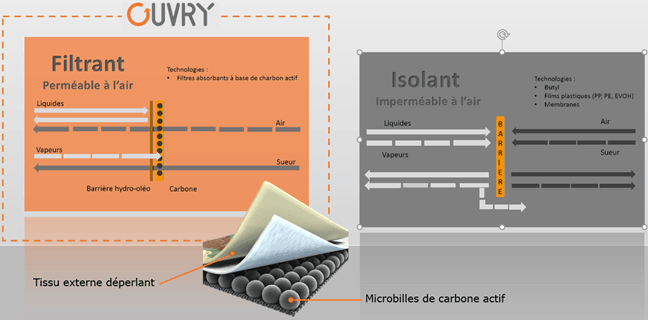
RET measurements carried out by an independent laboratory indicate that the POLYCOMBI® textile complex exhibits high breathability, thereby contributing to the reduction of heat stroke risk. It enables rapid evacuation of heat and sweat, decreasing hyperthermia risks.
The air permeability provided by POLYCOMBI® allows the user to endure on the field and thus limits the number of rotations and shifts to be implemented.
5. Frequently asked questions
What is heat stroke and what causes it?
Heat stroke (hyperthermia) occurs when the body’s natural thermoregulation mechanism — sweating — becomes ineffective. This happens during intense heat, sustained physical exertion and insufficient hydration. Body temperature then rises dangerously, making it a medical emergency for workers exposed outdoors.
What does French Decree No. 2025-482 require for agricultural workers?
French Decree No. 2025-482, known as the “heat stroke” decree, entered into force on 1 July 2025. It places prevention obligations on employers during periods of intense heat, including the provision of PPE capable of limiting or compensating for the effects of high temperatures, alongside appropriate worker hydration measures.
Why are liquid-tight PPE suits not recommended in high heat?
Liquid-tight PPE traps sweat between the skin and the plastic material, preventing evaporation. Since only sweat evaporation ensures effective thermoregulation, blocking it severely limits heat dissipation and increases the risk of heat stroke. Their use is therefore explicitly advised against during high-heat episodes.
How does the RET index measure PPE breathability?
The RET index (Evaporative Resistance Transfer) measures a textile’s resistance to sweat evaporation. The lower the RET, the more breathable the textile: a RET below 6 indicates a highly breathable textile, while a RET of 20 or above characterises a non-breathable, liquid-tight textile. It is the standard reference for comparing PPE breathability.
What standard governs the protection provided by POLYCOMBI®?
POLYCOMBI® meets the requirements of Standard 27065 with level 2 performance. It is designed using a filtering technology, permeable to air and water vapor, based on activated carbon microbeads. Its ergonomic design includes double cuffs at the arms and integrated socks at the feet for maximum protection.
📚 Sources & bibliography
- French Decree No. 2025-482 on prevention of risks related to intense heat episodes for workers — legifrance.gouv.fr [7]
{
"@context": "https://schema.org",
"@graph": [
{
"@type": "Article",
"@id": "[[URL_ARTICLE]]#article",
"headline": "Heat stroke and agricultural work: POLYCOMBI® as a solution to field requirements",
"description": "During heatwaves, agricultural workers exposed to phytopharmaceutical products face a dual risk: chemical contamination and heat stroke. French Decree No. 2025-482, in force since 1 July 2025, requires PPE that enables sweat evacuation. Only filtering, breathable suits guarantee effective thermoregulation through a low RET index, whereas liquid-tight suits trap heat and increase the risk of hyperthermia.",
"datePublished": "[[DATE_PUBLICATION_ISO]]",
"dateModified": "2025-05-28",
"inLanguage": "en",
"author": {
"@type": "Person",
"name": "[[AUTHOR_NAME]]",
"description": "French specialists in CBRN protection since 1999, suppliers to armed forces and civil security."
},
"publisher": {
"@type": "Organization",
"name": "Ouvry",
"url": "https://ouvry.com",
"logo": {
"@type": "ImageObject",
"url": "https://ouvry.com/logo.png"
}
},
"mainEntityOfPage": {
"@type": "WebPage",
"@id": "[[URL_ARTICLE]]"
},
"about": ["CBRN", "biological protection", "chemical protection", "PPE phytopharmaceutical", "heat stroke", "agricultural work"]
},
{
"@type": "FAQPage",
"@id": "[[URL_ARTICLE]]#faq",
"mainEntity": [
{
"@type": "Question",
"name": "What is heat stroke and what causes it?",
"acceptedAnswer": {
"@type": "Answer",
"text": "Heat stroke (hyperthermia) occurs when the body's natural thermoregulation mechanism — sweating — becomes ineffective. This happens during intense heat, sustained physical exertion and insufficient hydration. Body temperature then rises dangerously, making it a medical emergency for workers exposed outdoors."
}
},
{
"@type": "Question",
"name": "What does French Decree No. 2025-482 require for agricultural workers?",
"acceptedAnswer": {
"@type": "Answer",
"text": "French Decree No. 2025-482, known as the heat stroke decree, entered into force on 1 July 2025. It places prevention obligations on employers during periods of intense heat, including the provision of PPE capable of limiting or compensating for the effects of high temperatures, alongside appropriate worker hydration measures."
}
},
{
"@type": "Question",
"name": "Why are liquid-tight PPE suits not recommended in high heat?",
"acceptedAnswer": {
"@type": "Answer",
"text": "Liquid-tight PPE traps sweat between the skin and the plastic material, preventing evaporation. Since only sweat evaporation ensures effective thermoregulation, blocking it severely limits heat dissipation and increases the risk of heat stroke. Their use is therefore explicitly advised against during high-heat episodes."
}
},
{
"@type": "Question",
"name": "How does the RET index measure PPE breathability?",
"acceptedAnswer": {
"@type": "Answer",
"text": "The RET index (Evaporative Resistance Transfer) measures a textile's resistance to sweat evaporation. The lower the RET, the more breathable the textile: a RET below 6 indicates a highly breathable textile, while a RET of 20 or above characterises a non-breathable, liquid-tight textile. It is the standard reference for comparing PPE breathability."
}
},
{
"@type": "Question",
"name": "What standard governs the protection provided by POLYCOMBI®?",
"acceptedAnswer": {
"@type": "Answer",
"text": "POLYCOMBI® meets the requirements of Standard 27065 with level 2 performance. It is designed using a filtering technology, permeable to air and water vapor, based on activated carbon microbeads. Its ergonomic design includes double cuffs at the arms and integrated socks at the feet for maximum protection."
}
}
]
}