Individual decontamination reduces the toxic load deposited on clothing or the body following chemical or radiological contamination. It is achieved through removal or neutralization of toxic agents to limit exposure and prevent secondary contamination. Emergency decontamination prioritizes careful undressing followed by dry decontamination. OUVRY’s DECPOL ABS® wipes use a dual-action absorption-retention mechanism to decontaminate over 99% of chemical agents. The DECPOL RAD® wipe treats radiological contamination. These solutions represent an essential step before thorough decontamination.
Individual decontamination refers to any action aimed at reducing a toxic load deposited on clothing or the body following contamination and likely to cause poisoning. It is achieved through the removal and/or neutralization of the toxic agent.
It helps limit the duration of exposure and therefore the effects of the toxic agent, while also preventing secondary contamination of responders and the environment.
1. What is individual decontamination?
Incidents involving chemical agents may occur during industrial accidents, hazardous material transport, discovery of legacy munitions, or intentional CBRN attacks.
Chemical agents may exist in liquid, solid, or gaseous forms and can cause cutaneous, ocular, or systemic injuries. Rapid intervention is critical, as dermal absorption may begin upon first contact with the toxic substance. Decontamination [10] primarily aims to remove the toxic agent present on the skin surface in order to:
- halt its penetration into tissues
- reduce both local and systemic toxicity
2. Emergency decontamination
Emergency decontamination is intended to remove chemical agents—liquid or solid—very rapidly when they are present as direct contamination on clothing and exposed skin.
The first step consists of careful undressing to limit the transfer of contamination to the skin, allowing removal of a significant proportion of the contaminant. To accelerate intervention and optimize effectiveness, emergency decontamination does not require the immediate use of water. However, if contamination involves corrosive substances, thorough rinsing with water must be performed immediately after undressing.
Undressing is combined with a dry (non-aqueous) decontamination step, which can also be performed immediately.
When persistent agents are involved, emergency decontamination is generally followed by thorough decontamination carried out in dedicated facilities.
3. Dry decontamination
Dry decontamination relies on the use of absorbent or adsorbent materials to remove contaminants from the skin surface.
The standard technique consists of blotting the contaminated area for a few seconds, followed by wiping. This method significantly reduces the chemical load while minimizing the risk of spreading and secondary contamination.
Non-powdered, absorbent materials are recommended.
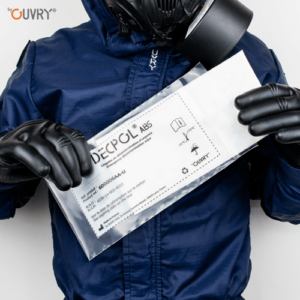
4. DECPOL ABS® wipe: a versatile emergency dry solution
To address emergency decontamination needs, the DECPOL ABS® wipe [11] provides an innovative and suitable solution for use on skin and contaminated surfaces. It is made from a non-powdering material that does not release particles or microfibers.
4.1. Mechanism of action
The DECPOL ABS® wipe operates through a dual-action mechanism:
- rapid absorption of chemical agents via the outer layers, which transfer the contaminant into the core of the wipe
- internal retention of the toxic substance, significantly reducing the risk of cross-contamination and spreading
It removes more than 99% of chemical agents by transfer and is effective against a broad range of toxic substances, including TICs and chemical warfare agents.
It enables immediate reduction of the chemical load on the skin, minimizes secondary contamination, and prepares the casualty for further decontamination if required.
4.2. Use
The DECPOL wipe is designed for rapid, simple, and intuitive use, suitable for armed forces and law enforcement, first responders and emergency services, as well as industries and critical infrastructure exposed to chemical risks.
5. DECPOL RAD® wipe for radiological decontamination
In cases of contamination by radioactive particles, the DECPOL RAD® wipe enables decontamination of both surfaces and skin.
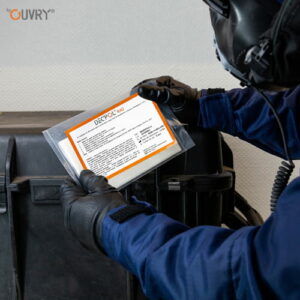
It is made from 100% viscose nonwoven material impregnated with RADECOM®, a degreasing radiological decontamination solution. This facilitates the detachment of radioactive particles, which are then removed by transfer onto the wipe.
6. The three levels of decontamination
Decontamination involves three successive levels:
- individual emergency decontamination
- thorough decontamination with showering, recommended in cases of persistent or corrosive agents, extensive contamination, or ongoing risk of secondary contamination after emergency decontamination
- medical management
Individual emergency decontamination is a critical step in the management of victims exposed to chemical agents. The use of specialized tools such as OUVRY DECPOL ABS® or RAD® wipes provides a simple, rapid, and effective solution to remove contaminants from skin and surfaces while limiting the risk of spread.
7. Frequently asked questions
What is individual decontamination?
Individual decontamination refers to any action aimed at reducing a toxic load deposited on clothing or the body following contamination. It is achieved through removal or neutralization of toxic agents, helping to limit exposure duration and prevent secondary contamination of responders and the environment. Rapid intervention is critical as dermal absorption may begin upon first contact with the toxic substance.
What is the difference between emergency and thorough decontamination?
Emergency decontamination aims to remove chemical agents very rapidly through careful undressing followed by dry decontamination, without immediate use of water (except for corrosive substances). Thorough decontamination, performed in dedicated facilities with showering, is recommended for persistent or corrosive agents, extensive contamination, or ongoing risk after emergency decontamination.
How does the DECPOL ABS® wipe work?
The DECPOL ABS® wipe uses a dual-action mechanism: rapid absorption of chemical agents by outer layers that transfer the contaminant into the core, followed by internal retention of the toxic substance. Made from non-powdering material, it removes more than 99% of chemical agents by transfer and is effective against TICs and chemical warfare agents, reducing cross-contamination risk.
What is the DECPOL RAD® wipe?
The DECPOL RAD® wipe is designed for radiological decontamination of surfaces and skin. It is made from 100% viscose nonwoven material impregnated with RADECOM®, a specialized degreasing solution that facilitates the detachment of radioactive particles. The particles are then removed by transfer onto the wipe, enabling effective decontamination of radiological contamination.
What are the three levels of decontamination?
The three successive levels are: 1) individual emergency decontamination (undressing and rapid dry decontamination), 2) thorough decontamination with showering in dedicated facilities if necessary, 3) medical management. This graduated approach effectively treats victims of chemical or radiological exposure while minimizing secondary contamination risks.