Sea-dumped weapons or munitions refer to devices that were lost or discarded, either accidentally or intentionally, in seas or lakes. These can include conventional weapons or munitions containing chemical warfare agents. This practice, widely used after the major conflicts of the 20th century, now raises major environmental concerns. This article reviews the historical context of these sea-dumping operations, examines the risks they pose to the environment, and provides an overview of the international governance framework.
1. Sea-dumping after the First World War
At the end of the First World War, vast quantities of weapons were stored in unsecure locations, such as barns, leading to leaks or accidental explosions. Very large stockpiles of chemical weapons were also accumulated.
In the 1920s, dumping them at sea seemed to be the simplest disposal solution. Bottom-opening split-hull barges were used to drop the munitions at designated sites, which were generally far from the coast and at great depths.
However, once informed of the nature of their cargo, ship captains frequently preferred to throw the shipment overboard before reaching the final destination to quickly rid themselves of these toxic materials, which were then lost track of.
2. Sea-dumping after the Second World War
2.1. A global practice
Sea-dumping practices resumed on a much larger scale after the Second World War. The demilitarization plan adopted at Potsdam mandated the destruction of thousands of tons of weapons and munitions. Once again, sea-dumping proved to be the fastest and least expensive method, and entire ships loaded with munitions were scuttled.
These operations took place in multiple regions worldwide, with weapons and munitions dumped at sea off the coasts of Australia, Japan, Canada, and around Hawaii.
2.2. Europe: the North Sea, the English Channel, and the Baltic Sea
In Europe, the North Sea, the English Channel, the Bay of Biscay, the Mediterranean Sea, and the Baltic Sea served as dumping grounds for massive quantities of munitions, particularly chemical ones. The North Sea is estimated to contain 300,000 tons of chemical weapons.
The OSPAR Commission [9], which defines international cooperation modalities for protecting the marine environment of the North-East Atlantic, has identified 148 dump sites in the North-East Atlantic Ocean, including 62 off the French coast. For instance, located off La Hague at a depth of 160 meters, the Hurd’s Deep (fosse des Casquets) received tons of chemical weapons in the years following both world wars. Very little quantitative data is available for the French Atlantic and Mediterranean coasts, but the dumped quantities are believed to be of the same order of magnitude.
The Baltic Sea also concentrates numerous chemical weapon dump sites. As in other regions of the world, the decision was made to sink ships and weapon stockpiles there after the Second World War. Hundreds of thousands of tons of chemical munitions were dumped by Germany, Britain, and the Soviet Union.
In the early 1990s, following the collapse of the Soviet Union, Russia additionally sank a large portion of the chemical weapons stored in former Soviet bases within the Baltic states.
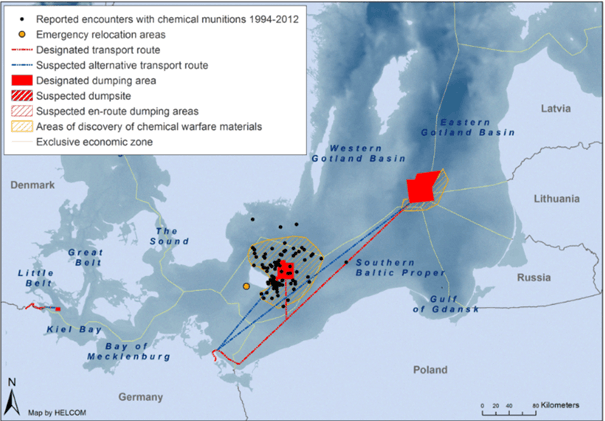
Sea-dumped chemical weapons in the Baltic Sea, source HELCOM
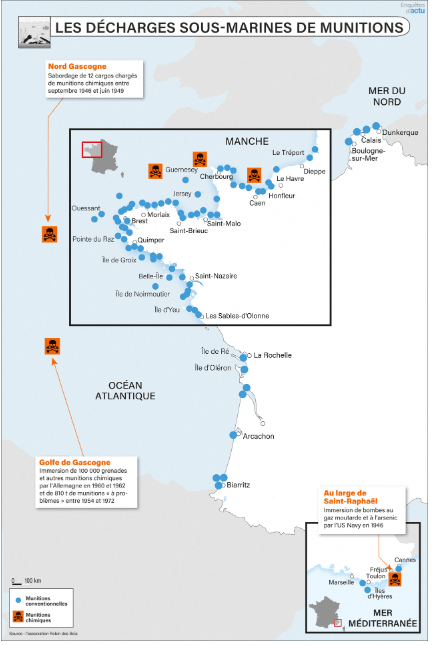
Sea-dumped weapon sites recorded off the French coast, source OSPAR
3. Nature of chemical agents and environmental risks
The total quantities of dumped chemical weapons and their exact locations remain largely unknown. The primary chemical warfare agents likely resting on the seabed are mustard gas, tabun, and white phosphorus. They can leak out of containers — which were also sometimes riddled with bullets to make them sink faster — and contaminate the seabed.
Pollution risks worsen over the years because corrosion attacks the containers, causing the munitions to degrade and contaminate sediments, water, and the food chain.
Direct contact risks also exist for fishermen and offshore workers. For example, mustard gas, which forms a viscous mass on the water’s surface, has caused injuries among fishermen in the Baltic Sea. White phosphorus, an incendiary agent, is also occasionally washed ashore on certain beaches in the southern Baltic, presenting burn risks for swimmers.
4. International governance and recommendations
The lack of a comprehensive inventory of dump sites complicates public information efforts. With the expansion of maritime economic activities, sites are increasingly discovered during marine exploration work for the future installation of wind turbines, submarine cables, or pipelines.
For instance, in the Baltic Sea, surveys preceding the construction of the Nord Stream gas pipelines revealed several dump zones. In France, the construction of Port 2000 in Le Havre also led to the localization of dumped munitions.
Most information known to date regarding dump zones has been collected under the auspices of the OSPAR Commission or HELCOM, an intergovernmental commission responsible for environmental issues in the Baltic Sea. Although United Nations member states banned the dumping of chemical weapons at the end of the 20th century, past dumping operations and their consequences remain classified as “defense secrets” in many of them. This is the case in France, which, according to OSPAR Commission data, contains the majority of the recorded deposits in Europe.
For the Baltic Sea, European programs (CHEMSEA and DAIMON) launched from 2014 onwards enabled coordinated awareness actions with riparian countries (Germany, Finland, Lithuania, Norway, Poland, Sweden). Their objectives were to conduct toxicity studies on chemical agents, assess environmental impacts, and raise public awareness.
The OSPAR Commission has recognized the danger that dumped chemical weapons pose to the environment and human safety, establishing a framework to map sites using military and civil archives and to inform relevant stakeholders of the risks. Given the scale of the stockpiles and the limited capacity of existing treatment facilities worldwide, it recommends leaving the munitions in place unless there is an immediate danger.
It encourages at the same time research into their corrosion and environmental effects, particularly for chemical munitions. Only cooperation among the concerned countries will lead to a better long-term understanding of the environmental consequences of these dumping operations.
5. A legal blind spot: a problem for future generations
Dumped chemical weapons fall outside the scope of the Chemical Weapons Convention (CWC), which entered into force in 1997. Indeed, munitions dumped before January 1, 1977 — which represent the vast majority of them — are subject to no obligations under the CWC (declaration, recovery, storage, or destruction).
This results in a vacuum of responsibility: no state is legally bound to finance or organize their elimination, whether it is the country that manufactured them, the one that dumped them, or the one whose territorial waters currently host them. This lack of a binding framework transforms a 20th-century military legacy into an environmental and health burden that no one is legally compelled to manage, and which is currently merely monitored rather than treated.
With the progressive degradation of containers and the multiplication of maritime uses (wind farms, cables, pipelines, aggregate extraction), the risk will only increase, passing an environmental and financial bill down to future generations that the generation that produced these weapons never had to pay.
Faced with this vacuum, the solution most frequently cited by experts and certain environmental organizations is the creation of a dedicated international fund, modeled after existing mechanisms like the Global Environment Facility (GEF) or the International Oil Pollution Compensation Funds (IOPC Funds).
Such a fund could be financed through a shared responsibility approach: contributions from former belligerents and historical chemical weapon manufacturers, coastal states currently benefiting from the economic use of these seas (offshore energy, fishing, shipping), and, where appropriate, private operators whose submarine projects encounter these munitions.
It would be intended to finance three areas:
- establishing a comprehensive cartographic inventory of dumping zones, which is currently fragmented and largely covered by defense secrecy;
- developing safe and cost-effective underwater recovery technologies for corroded and unstable munitions;
- funding suitable destruction facilities.
Shared governance between already competent regional organizations (OSPAR Commission, HELCOM) and a broader international body, for instance under the aegis of the Organisation for the Prohibition of Chemical Weapons (OPCW) or the United Nations, would provide this transboundary issue with the political legitimacy and financial continuity it currently lacks.
6. Frequently asked questions
What is a sea-dumped munition and why is it dangerous?
A sea-dumped munition is an explosive or chemical device that was lost or intentionally discarded in a sea or lake. It is dangerous because containers corrode over time, releasing chemical agents such as mustard gas or tabun that contaminate sediments, water, and the food chain. Direct contact risks also exist for fishermen and offshore workers who may encounter these materials during their activities.
How many tons of chemical weapons lie on the floor of the North Sea?
According to available estimates, the North Sea is believed to contain approximately 300,000 tons of chemical weapons. The OSPAR Commission has also identified 148 dump sites in the North-East Atlantic Ocean, including 62 off the French coast. Data remains fragmentary for the French Atlantic and Mediterranean coastlines, but dumped quantities are believed to be of the same order of magnitude.
Why does the Chemical Weapons Convention not apply to sea-dumped munitions?
The Chemical Weapons Convention (CWC), which entered into force in 1997, excludes from its scope munitions dumped before January 1, 1977 — the vast majority of existing stocks. No state is therefore legally bound to declare, recover, store, or destroy these munitions, creating a legal and financial vacuum of responsibility that leaves these weapons unaddressed under international law.
Which European programs address the problem of sea-dumped weapons in the Baltic Sea?
The CHEMSEA and DAIMON programs, launched from 2014 onwards, coordinated awareness actions with Baltic Sea riparian countries (Germany, Finland, Lithuania, Norway, Poland, Sweden). Their objectives were to assess the toxicity of chemical agents, evaluate environmental impacts, and raise public awareness of the risks associated with these sea-dumped munitions across the region.
What solution is recommended for managing sea-dumped munitions?
Given the scale of the stockpiles and the limited capacity of existing treatment facilities, the OSPAR Commission recommends leaving the munitions in place unless there is an immediate danger. It encourages research into their corrosion and environmental effects. Experts also advocate for the creation of a dedicated international fund to finance a comprehensive inventory, the development of safe recovery technologies, and suitable destruction facilities.
📚 Sources & bibliography
- Wikipedia — Munition immergée: https://fr.wikipedia.org/wiki/Munition_immerg%C3%A9e [10]
- Wikipedia — Convention internationale OSPAR: https://fr.wikipedia.org/wiki/Convention_internationale_OSPAR [11]
- European Commission — CHEMSEA program (chemical munitions in the Baltic Sea): https://ec.europa.eu/regional_policy/fr/projects/germany/chemsea-tackles-problem-of-chemical-munitions-in-the-baltic-sea [12]
- DAIMON Project: http://www.daimonproject.com/ [13]
- Mediapart — Des décharges d’armes chimiques au large des côtes françaises: https://blogs.mediapart.fr/temps-analytique/blog/070622/des-decharges-darmes-chimiques-au-large-des-cotes-francaises [14]
- HELCOM — Sea-dumped chemical munitions in the Baltic Sea: https://helcom.fi/baltic-sea-trends/hazardous-subtances/sea-dumped-chemical-munitions/ [15]
{
"@context": "https://schema.org",
"@graph": [
{
"@type": "Article",
"@id": "[[URL_ARTICLE]]#article",
"headline": "Sea-dumped weapons and munitions: a legacy of world war conflicts",
"description": "Millions of tons of conventional and chemical munitions lie on the seabed of the world's oceans and European seas, a legacy of the two World Wars. Dumped after 1918 and 1945 as a rapid disposal solution, these weapons threaten marine ecosystems, fishermen, and offshore workers. A legal blind spot persists: no state is legally bound to organize their elimination.",
"datePublished": "[[DATE_PUBLICATION_ISO]]",
"dateModified": "2026-06-24",
"inLanguage": "en",
"author": {
"@type": "Person",
"name": "[[AUTHOR_NAME]]",
"description": "[[SHORT_BIO_25_WORDS]]"
},
"publisher": {
"@type": "Organization",
"name": "Ouvry",
"url": "https://ouvry.com",
"logo": {
"@type": "ImageObject",
"url": "https://ouvry.com/logo.png"
}
},
"mainEntityOfPage": {
"@type": "WebPage",
"@id": "[[URL_ARTICLE]]"
},
"about": ["CBRN", "sea-dumped chemical weapons", "underwater munitions", "marine pollution"]
},
{
"@type": "FAQPage",
"@id": "[[URL_ARTICLE]]#faq",
"mainEntity": [
{
"@type": "Question",
"name": "What is a sea-dumped munition and why is it dangerous?",
"acceptedAnswer": {
"@type": "Answer",
"text": "A sea-dumped munition is an explosive or chemical device that was lost or intentionally discarded in a sea or lake. It is dangerous because containers corrode over time, releasing chemical agents such as mustard gas or tabun that contaminate sediments, water, and the food chain. Direct contact risks also exist for fishermen and offshore workers who may encounter these materials during their activities."
}
},
{
"@type": "Question",
"name": "How many tons of chemical weapons lie on the floor of the North Sea?",
"acceptedAnswer": {
"@type": "Answer",
"text": "According to available estimates, the North Sea is believed to contain approximately 300,000 tons of chemical weapons. The OSPAR Commission has also identified 148 dump sites in the North-East Atlantic Ocean, including 62 off the French coast. Data remains fragmentary for the French Atlantic and Mediterranean coastlines, but dumped quantities are believed to be of the same order of magnitude."
}
},
{
"@type": "Question",
"name": "Why does the Chemical Weapons Convention not apply to sea-dumped munitions?",
"acceptedAnswer": {
"@type": "Answer",
"text": "The Chemical Weapons Convention (CWC), which entered into force in 1997, excludes from its scope munitions dumped before January 1, 1977 — the vast majority of existing stocks. No state is therefore legally bound to declare, recover, store, or destroy these munitions, creating a legal and financial vacuum of responsibility that leaves these weapons unaddressed under international law."
}
},
{
"@type": "Question",
"name": "Which European programs address the problem of sea-dumped weapons in the Baltic Sea?",
"acceptedAnswer": {
"@type": "Answer",
"text": "The CHEMSEA and DAIMON programs, launched from 2014 onwards, coordinated awareness actions with Baltic Sea riparian countries (Germany, Finland, Lithuania, Norway, Poland, Sweden). Their objectives were to assess the toxicity of chemical agents, evaluate environmental impacts, and raise public awareness of the risks associated with these sea-dumped munitions across the region."
}
},
{
"@type": "Question",
"name": "What solution is recommended for managing sea-dumped munitions?",
"acceptedAnswer": {
"@type": "Answer",
"text": "Given the scale of the stockpiles and the limited capacity of existing treatment facilities, the OSPAR Commission recommends leaving the munitions in place unless there is an immediate danger. It encourages research into their corrosion and environmental effects. Experts also advocate for the creation of a dedicated international fund to finance a comprehensive inventory, the development of safe recovery technologies, and suitable destruction facilities."
}
}
]
},
{
"@type": "BreadcrumbList",
"itemListElement": [
{ "@type": "ListItem", "position": 1, "name": "Home", "item": "https://ouvry.com" },
{ "@type": "ListItem", "position": 2, "name": "Blog", "item": "https://ouvry.com/blog" },
{ "@type": "ListItem", "position": 3, "name": "[[CATEGORY]]", "item": "[[URL_CATEGORY]]" },
{ "@type": "ListItem", "position": 4, "name": "Sea-dumped weapons and munitions: a legacy of world war conflicts", "item": "[[URL_ARTICLE]]" }
]
}
]
}