Medical observations of mustard gas victims led to the development of the first alkylating anticancer agents. After the world wars, scientists noticed that mustard gas sharply reduced blood cells and targeted rapidly proliferating cells. Nitrogen mustards (mechlorethamine, melphalan, chlorambucil) developed in the 1950s bind to DNA and block cellular replication. Cyclophosphamide, a more tolerable prodrug, remains widely used today to treat lymphomas, leukemias, breast and lung cancers. This historical conversion illustrates how a chemical weapon contributed to a major drug family.
1. Wartime observations as the starting point for a therapeutic pathway
Following World War I, scientists had already observed that individuals exposed to mustard gas [7] exhibited a marked reduction in blood cells, particularly white blood cells.
Later, during World War II, the medical management of victims of a large accidental mustard gas release further demonstrated that this substance selectively targets rapidly proliferating cells.
These observations suggested that chemical derivatives of mustard gas might act on fast-dividing cells, such as cancer cells, thereby opening unexpected avenues for research.
2. Nitrogen mustards: the first alkylating agents
Initial therapeutic investigations focused on nitrogen mustards [8], compounds structurally related to mustard gas but modified for medical use.
In the 1950s, this work led to the development of the first alkylating agents, a new class of anticancer drugs: mechlorethamine, melphalan, and chlorambucil. These molecules bind to DNA, induce damage, and inhibit cellular replication. They proved particularly effective against rapidly dividing cancer cells.
They were first used in disseminated malignancies such as lymphomas and leukemias, before being applied to solid tumors.
These agents marked a major breakthrough, as they were among the first truly effective chemotherapies against cancer.
3. Cyclophosphamide: a molecule designed for improved targeting
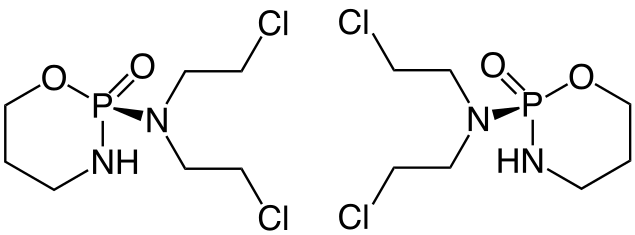
Another compound was developed in parallel to improve tolerability and broaden clinical use: cyclophosphamide.
 [9]
[9]
Unlike earlier nitrogen mustards, this molecule is a prodrug. It is administered in an inactive form and becomes activated through metabolic processes to produce the desired physiological effect. This activation allows for better systemic distribution and more controlled therapeutic efficacy.
4. Drugs still widely used in oncology today
The first nitrogen mustards paved the way for modern chemotherapy. Due to significant side effects, mechlorethamine now has limited indications. In contrast, melphalan and chlorambucil remain commonly prescribed.
Despite its potential toxicity, cyclophosphamide continues to play a major role in many chemotherapy regimens. It is often combined with other anticancer agents to enhance efficacy and reduce the emergence of tumor resistance.
It is used in the treatment of several cancers, including breast cancer and certain lung cancers, as well as many hematologic malignancies, notably lymphomas, leukemias, and multiple myeloma.
5. A historical conversion: from chemical weapon to cancer therapy
The development of alkylating agents illustrates how a substance originally used as a chemical weapon contributed to the emergence of a major class of anticancer drugs.
Decades of research have enabled the identification of effective molecules, optimization of dosing, and management of adverse effects.
Cyclophosphamide remains a cornerstone agent in this class, widely used and integrated into modern therapeutic strategies combining chemotherapy and targeted therapies.
6. Bibliography :
L’histoire des gaz moutarde, de la substance toxique à la substance thérapeutique : exemple du cyclophosphamide, Ludovic Marotel
https://hal.univ-lorraine.fr/hal-03298133v1 [10]
https://planet-vie.ens.fr/thematiques/sante/traitements/les-agents-alkylants-en-chimiotherapie [11]
7. Frequently asked questions
How did mustard gas lead to the development of anticancer drugs?
After the world wars, scientists observed that mustard gas victims exhibited marked reductions in blood cells and that the substance selectively targeted rapidly proliferating cells. These observations suggested that chemical derivatives could act on fast-dividing cells like cancer cells, opening unexpected research pathways that led to the development of alkylating anticancer agents.
What are nitrogen mustards?
Nitrogen mustards are compounds structurally related to mustard gas but modified for medical use. Developed in the 1950s, they include mechlorethamine, melphalan, and chlorambucil. These molecules bind to DNA, induce damage, and inhibit cellular replication. They were among the first truly effective chemotherapies against cancer and marked a major breakthrough in oncology.
What is cyclophosphamide and how does it work?
Cyclophosphamide is a prodrug developed to improve the tolerability of nitrogen mustards. It is administered in an inactive form and activated through metabolic processes in the body. This activation allows for better systemic distribution and more controlled therapeutic efficacy. It remains widely used today and is integrated into modern therapeutic strategies combining chemotherapy and targeted therapies.
For which types of cancer is cyclophosphamide used?
Cyclophosphamide is used to treat several cancers: breast cancer, certain lung cancers, and many hematologic malignancies including lymphomas, leukemias, and multiple myeloma. Despite its potential toxicity, it continues to play a major role in many chemotherapy regimens and is often combined with other anticancer agents to enhance efficacy.
Are nitrogen mustards still used today?
Yes, certain nitrogen mustards remain in use in modern oncology. Mechlorethamine now has limited indications due to significant side effects. In contrast, melphalan and chlorambucil remain commonly prescribed. Cyclophosphamide remains a cornerstone agent in this class, widely used in many contemporary chemotherapy protocols and modern therapeutic strategies.