Fifteen years after the Fukushima nuclear disaster, the sector continues to learn from this major accident. Decommissioning will continue until 2050-2060, requiring extraction of 880 tonnes of corium. Contaminated water treated by the ALPS system is discharged into the sea according to IAEA standards. France created the Nuclear Rapid Action Force (FARN) in 2014, capable of responding within 24 hours. Nuclear PPE must protect against irradiation and radiological contamination, with OUVRY’s POLYCOMBI® equipping the FARN.
Fifteen years after the Fukushima disaster, the nuclear sector continues to draw lessons from this major accident. Ongoing decommissioning, ocean discharges, strengthened emergency response arrangements, and evolving protective equipment: an overview of the current situation and the radiological protection challenges facing operators.
1. The Fukushima nuclear disaster: a reminder of the facts
The Fukushima nuclear disaster remains vivid in collective memory. On March 11, 2011, a magnitude-9 earthquake struck Fukushima Prefecture, located about 300 km northeast of Tokyo. The quake triggered the automatic shutdown of the reactors at the Fukushima Daiichi nuclear power plant and the startup of emergency diesel generators. Less than an hour later, a tsunami generated by the earthquake swept over the coastline, with a 15-meter-high wave hitting the plant. This caused the failure of the diesel generators and a total loss of power supply.
A combination of technical and organizational vulnerabilities then led to the shutdown of emergency cooling systems for the reactors and the spent fuel pools. The lack of cooling resulted in the partial or total meltdown of three reactors, causing radioactive releases. These releases were exacerbated by fires and explosions in the days that followed. The population was evacuated, and a shelter-in-place zone was established within a 30-km radius.
2. Current situation at the Fukushima Daiichi plant
2.1. Decommissioning of the plant
Given the extent of the damage and the difficulties involved in operations, decommissioning has proven extremely complex. Around 880 tonnes of corium—a mixture of nuclear fuel, fission products, and reactor structural materials—must be removed. A first sample was taken in 2024. Full decommissioning of the facilities is planned for the 2050-2060 timeframe, a schedule that appears difficult to maintain.
2.2. Discharge of contaminated water into the sea
The Advanced Liquid Processing System (ALPS) implemented at Fukushima is a filtration process that removes almost all radionuclides from contaminated water, except for tritium, prior to its release into the environment. The discharges into the sea are nevertheless carried out in accordance with international safety standards established by the International Atomic Energy Agency.
3. Implications for radiological protection
3.1. Strengthening nuclear emergency response capabilities
It was inadequate protection against a major natural disaster—not an initial nuclear malfunction—that triggered the cascade of failures leading to the Fukushima nuclear accident. These circumstances prompted states to reassess and analyze their emergency response arrangements for disasters of this kind.
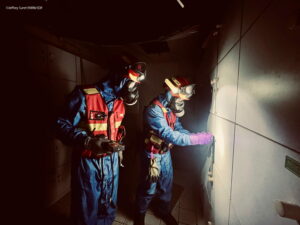
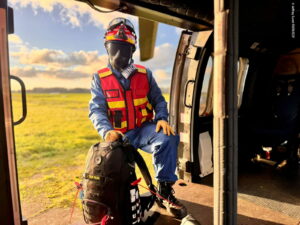
In France, EDF [12] created the Force d’action rapide du nucléaire (FARN) [13] in 2014. This unit, unique worldwide, is capable of intervening at any nuclear power plant in the country within less than 24 hours in the event of a severe accident. It has dedicated equipment, specialized protective clothing, and specific training in nuclear safety and crisis management. Its mission is to operate in extreme situations that go far beyond the scenarios considered during the design of nuclear sites.
At the same time, the French authorities expanded the intervention radius of the Emergency Response Plan (PPI) from 10 to 20 km around nuclear power plants.
4. What personal protective equipment (PPE) is used in the nuclear sector?
4.1. Types of radiological risks
Operations at nuclear power plants require protection against two types of risks:
- Irradiation risk: the individual is exposed to ionizing radiation emitted by a radioactive source. Severity depends on the type of radiation and the dose received. The risk associated with nuclear radiation is influenced by several factors, including distance from the radiation source, exposure time, and shielding
- Radiological contamination risk: radiological contamination refers to the unintended entry of radioactive materials into the body through ingestion, inhalation, or skin contact. A distinction is made between:
- external contamination: radionuclides present in the environment deposit on the skin or clothing
- internal contamination: radioactive materials enter the body, for example through ingestion or inhalation
Both types of contamination can have serious health consequences, making it essential to monitor and protect individuals exposed to these risks.
5. Performance and limitations of PPE in the nuclear sector
The level of protection provided by personal protective equipment (PPE) [14] against irradiation risk depends heavily on the type of radiation involved. PPE is highly effective against contamination but far less so against external irradiation, especially for highly penetrating radiation such as X-rays and gamma rays. For these so-called penetrating radiations, operators seek protection through shielding—such as lead aprons—or by using remote handling.
5.1. OUVRY expertise in CBRN protection in nuclear environments
The POLYCOMBI® [15] suit developed by OUVRY is an air-permeable garment based on the use of a filtering medium made of activated carbon microbeads. Unlike sealed suits or fully encapsulating outfits, it allows heat and perspiration to dissipate quickly, offering improved wearer comfort. It provides protection against type 5-B radioactive particles. The POLYCOMBI® is used by the FARN.
OUVRY also offers DECPOL RAD® wipe [16]s, which enable manual decontamination of all types of surfaces and equipment, as well as the skin.
A member of the Nuclear Valley cluster [17], the group is already strongly established in the field of nuclear PPE. Its integration in 2025 into the Nuclear Accelerator program has further strengthened its commitment to protecting nuclear operators.
6. Frequently asked questions
What happened during the Fukushima disaster in 2011?
On March 11, 2011, a magnitude-9 earthquake followed by a 15-meter-high tsunami struck the Fukushima Daiichi nuclear power plant. The failure of diesel generators caused the shutdown of cooling systems, leading to partial or total meltdown of three reactors and radioactive releases exacerbated by fires and explosions. A 30-km evacuation zone was established around the plant.
What is the current status of Fukushima decommissioning?
Decommissioning of the Fukushima Daiichi plant has proven extremely complex. It requires the removal of 880 tonnes of corium, a mixture of nuclear fuel and reactor materials. A first sample was taken in 2024. Full decommissioning is planned for the 2050-2060 timeframe, a schedule that appears difficult to maintain given the technical challenges involved.
What is the Nuclear Rapid Action Force (FARN)?
The FARN is a unique unit created by EDF in 2014 following lessons from Fukushima. It can intervene at any French nuclear power plant within 24 hours in case of severe accident. It has specific equipment, protective clothing like OUVRY’s POLYCOMBI®, and dedicated training in nuclear safety and crisis management for extreme situations beyond design scenarios.
What are the two types of radiological risks in nuclear operations?
Nuclear operations require protection against two risks: irradiation risk (exposure to ionizing radiation emitted by a radioactive source) and radiological contamination risk. Contamination can be external (deposition of radionuclides on skin or clothing) or internal (entry of radioactive materials into the body through ingestion, inhalation, or skin contact).
How does OUVRY’s POLYCOMBI® protect nuclear operators?
The POLYCOMBI® is an air-permeable suit using a filtering medium made of activated carbon microbeads. Unlike sealed suits, it rapidly dissipates heat and perspiration for improved comfort. It provides protection against type 5-B radioactive particles and equips the FARN. OUVRY also offers DECPOL RAD® wipes for surface and skin decontamination.