




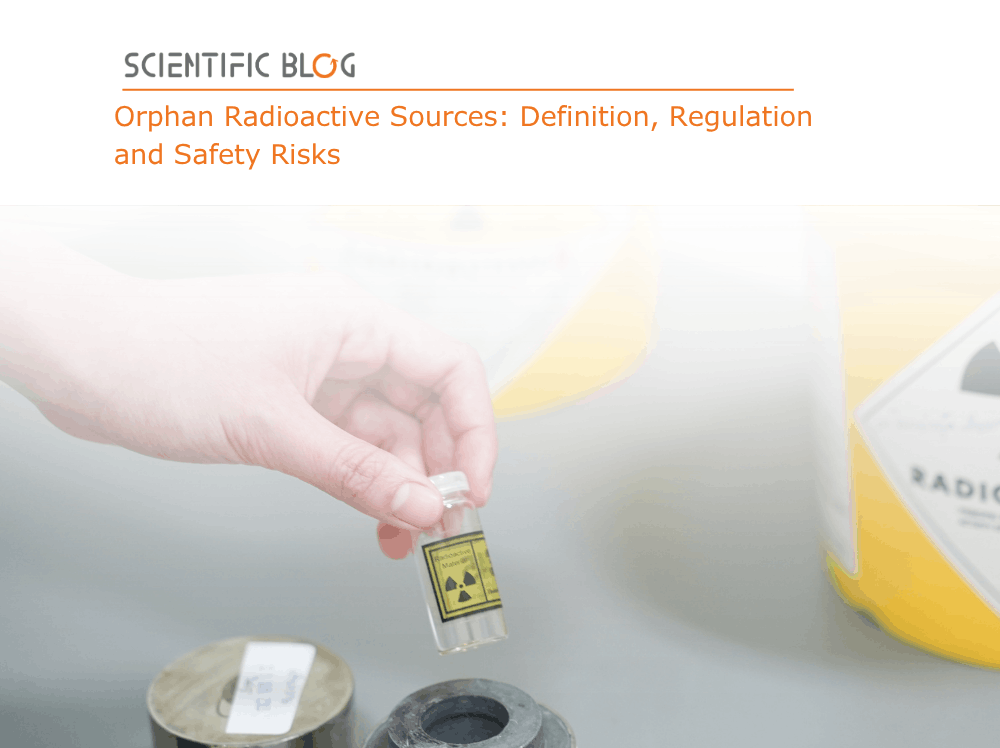
An orphan radioactive source is a radioisotope concentration above exemption thresholds that is no longer under regulatory control, as a result of loss, abandonment or theft. It poses a significant health and security risk: the leading cause of serious incidents worldwide, it can also be used to build dirty bombs. In France, the law requires mandatory reporting and State management when no responsible party can be identified. At the international level, the IAEA coordinates traceability and logs incidents through two dedicated databases.
1. What is an orphan radioactive source?
An orphan radioactive source is a concentration of radioisotope above exemption thresholds that is no longer under the control of a person or institution authorised to hold it. It may result from poor management leading to its loss or abandonment, or from theft.
Radioactive materials are widely used in medicine, research and industry. If they are not kept under regulatory control after their initial delivery, these materials — or waste contaminated by them — can end up in the rubbish or be mistakenly recycled. Unless identified and secured in time, they pose a danger to people and the environment.
2. French regulation: who is responsible for an orphan source?
Under French law, a radioactive source is considered orphan when no responsible party can be identified. Its management then falls to the State. In practice, the legislation provides for:
- mandatory reporting: the discovery of a radioactive source outside a regulated use must be reported to the State’s local representative, who informs the ASNR (France’s Nuclear Safety and Radiation Protection Authority);
- a tiered chain of responsibility: depending on its origin, the source is either recovered by the party responsible for the original nuclear activity, or its original owner is held responsible; as a last resort, if no responsible party can be identified, the State calls on Andra (the National Agency for Radioactive Waste Management) to secure it.
3. Tracking high-activity sources: the Euratom directive
The French Public Health Code has transposed European Directive Euratom 2003/122, which sets out a traceability framework covering the entire life cycle of a high-activity radioactive source — that is, a source whose activity exceeds a regulatory threshold set according to the risk it poses:
- physical identification and marking, so it remains recognisable even if ownership or use changes;
- mandatory prior authorisation for any possession, ensuring the source never circulates unchecked;
- a register of holders, maintained by the ASNR;
- a supplier responsibility principle: whoever distributes the source must take it back at the end of its life, or if the holder can no longer use it;
- mandatory reporting in the event of loss or theft.
The aim is to ensure that no high-activity radioactive source can ever disappear administratively.
4. International tracking by the IAEA
At the international level, the International Atomic Energy Agency (IAEA) maintains the International Catalogue of Sealed Radioactive Sources and Devices, which provides technical information on radioactive sources, devices and transport packages known to be currently in use or to have been used in the past. This data helps ensure sources are tracked from production through to authorised disposal or storage.
5. Why tracking radioactive sources matters
Orphan radioactive sources are the leading cause of serious incidents and therefore pose a significant health risk. Such incidents typically occur after a facility housing radioactive sources (a hospital, industrial site or military base) is abandoned or closed down, when the absence of proper decommissioning leaves the sources to be picked up by scrap dealers or others unaware of what they are handling.
Several serious incidents causing contamination and deaths occurred worldwide during the 1980s and 1990s. Their number has fallen sharply since the 2000s, thanks in large part to the traceability measures now in place.
Since 1995, the IAEA has also maintained the Incident and Trafficking Database (ITDB), which logs lost or stolen radioactive materials along with cases of smuggling, unauthorised storage or discovery. The ITDB records around a hundred incidents worldwide each year. By the end of 2025, it had logged 4,580 incidents in total, including more than 350 linked to trafficking and a further 1,100 potentially tied to illicit activity.
6. Terrorism risks linked to orphan sources
Orphan sources can be used to build “dirty bombs” — radiological dispersal devices in which radioactive material is placed inside an explosive device that scatters it upon detonation.
The threat of a stolen sealed source being planted in a public place to trigger contamination panic is also real, well-documented, and taken seriously by the authorities. While the risk of mass casualties in such a scenario remains fairly low, the primary goal of such an act would be to destabilise society through fear. The insidious irradiation of public spaces could sow distrust among users of public transport and, in turn, shake the economy.
7. Prevention measures taken by states
Beyond national and international traceability measures, states deploy additional safeguards to limit this risk and ensure security, such as installing detection portals at borders, raising public awareness, and running simulation exercises with first responders.
Orphan radioactive sources are the leading cause of serious incidents and pose both a significant health risk and a potential vector for terrorist acts aimed at destabilising society through fear.
8. Frequently asked questions
What is an orphan radioactive source and how does it become one?
An orphan radioactive source is a radioisotope concentration above exemption thresholds that is no longer under the control of an authorised person or institution. It typically becomes orphan through poor management leading to loss or abandonment — particularly when a hospital, industrial site or military base is closed without proper decommissioning — or as a result of theft. Unless identified and secured promptly, it poses a direct danger to people and the environment.
What does French law require when an orphan radioactive source is discovered?
French law imposes mandatory reporting to the State’s local representative, who in turn notifies the ASNR. Responsibility is then assigned through a tiered chain: the source is first returned to the party responsible for the original nuclear activity, or its original owner is held liable. If no responsible party can be identified, the State calls on Andra, the National Agency for Radioactive Waste Management, to secure it.
What is the Euratom Directive 2003/122 and what does it require?
Euratom Directive 2003/122, transposed into the French Public Health Code, establishes a mandatory traceability framework for the entire life cycle of high-activity radioactive sources. It requires physical identification and marking, prior authorisation for any possession, a register of holders maintained by the ASNR, an obligation for suppliers to recover sources at end of life, and mandatory reporting of any loss or theft — so that no high-activity source can ever disappear administratively.
How does the IAEA monitor radioactive sources internationally?
The IAEA operates two complementary tools: the International Catalogue of Sealed Radioactive Sources and Devices, providing technical data on sources in use or previously used, and the Incident and Trafficking Database (ITDB), maintained since 1995. The ITDB logs around a hundred incidents per year worldwide; by end 2025 it had recorded 4,580 incidents in total, including more than 350 linked to trafficking and 1,100 potentially tied to illicit activity.
Can orphan radioactive sources be used for terrorist purposes?
Yes. Orphan sources can be used to build dirty bombs — radiological dispersal devices — or planted in public spaces to trigger contamination panic. While the risk of mass casualties remains fairly low in the latter scenario, the primary aim would be to destabilise society through fear, sowing distrust in public transport and damaging the economy. States counter this through border detection portals, public awareness campaigns, and first-responder simulation exercises.