



Becquerel, gray, sievert, Geiger counter… radioactivity comes with technical jargon that can seem impenetrable. This article offers clear explanations to help you make sense of these concepts.
1. What is radioactivity?
In nature, most atomic nuclei (made up of protons and neutrons and surrounded by electrons) are stable: they remain unchanged and are electrically neutral. Some combinations of neutrons, protons and electrons, however, form unstable nuclei, with too many protons, too many neutrons, too many electrons, or an excess of all three. Because nature always tends towards a stable state, unstable nuclei spontaneously transform to correct these imbalances. They release the excess energy associated with their instability in the form of invisible radiation, known as ionizing radiation. This process is called radioactive decay, or radioactivity.
The higher the activity of an unstable element, the more energy is released, and the higher the radioactivity. There are three types of radiation, each with a different penetrating power:
- Alpha radiation is stopped by a sheet of paper.
- Beta radiation is stopped by a sheet of aluminum.
- Gamma radiation is far more penetrating. It can travel several hundred meters through air, and a thick layer of lead or concrete is needed to stop it.
Three units are used to measure radioactivity and its effects. They quantify the amount of radiation emitted per second, the amount of energy absorbed, and the biological effects of that energy.
2. Units of measurement for radioactivity
2.1. The becquerel
The becquerel (Bq) measures the number of nuclear transformations per second and is used to express the activity of a radioactive material. One becquerel corresponds to one spontaneous decay of an unstable nucleus per second.
Radioactivity is generally expressed in multiples of the becquerel: kilobecquerels (one thousand becquerels), megabecquerels (one million becquerels) and gigabecquerels (one billion becquerels).
It is often expressed per unit of mass (Bq/kg), volume (Bq/L or Bq/m³) or surface area (Bq/m²).
Radioactivity occurs naturally. Under normal conditions, for example, ambient air has an activity of 10 Bq/m³. Other natural examples include milk, at 70 Bq/L, and the adult human body, with an average activity of 120 Bq/kg.
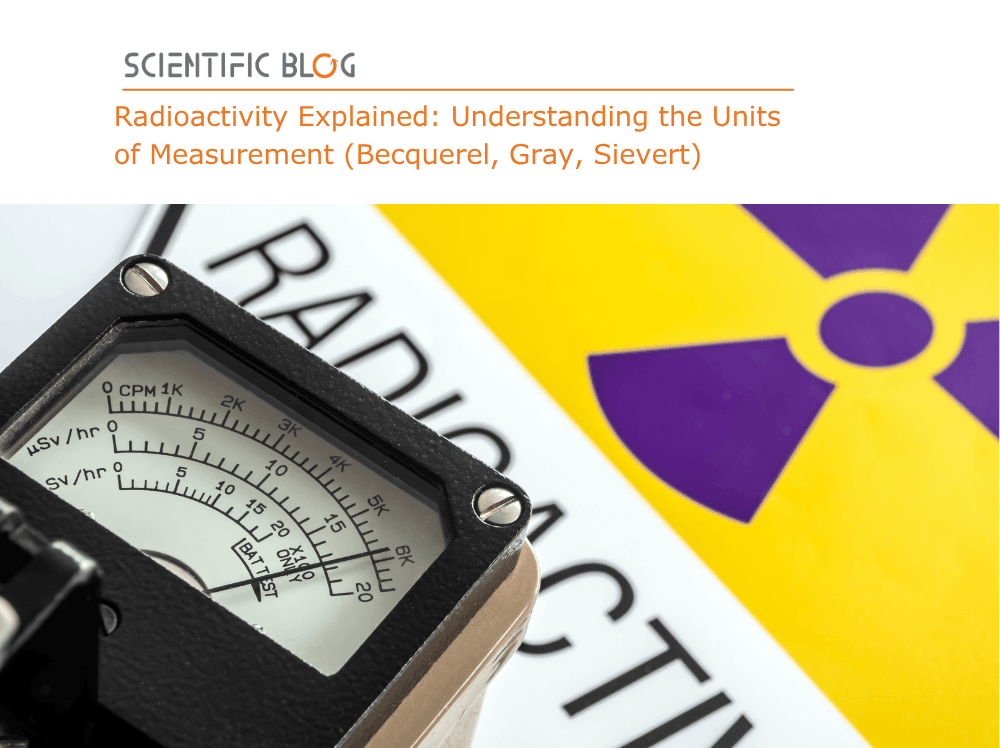
Becquerels are measured using instruments such as the Geiger-Müller counter, which detects beta and gamma radiation and emits an audible signal when exposed to it. The amplitude of the electrical signal indicates the number of decays per second.
2.2. The gray
The gray (Gy) measures the amount of radiation absorbed by matter (a living organism or an object). It corresponds to the energy deposited by nuclear decay per unit mass of the exposed material: 1 gray equals 1 joule per kilogram.
When time is factored into this measurement, it is referred to as the dose rate. For example, the effect of a dose rate of 1 Gy/h (i.e., a dose equivalent to 1 Gy over one hour) will differ depending on whether the material is exposed for a few seconds or for a full hour.
2.3. The sievert
Unlike the two previous units, the sievert is not measured but calculated. It assesses the potential biological effects of radioactivity on exposed living tissue, taking into account the type of radiation and the radiosensitivity of the organs involved.
It expresses the equivalent dose, i.e., the effect on a tissue or organ exposed to radioactivity. Each tissue and organ has its own vulnerability to a given type of radiation. For instance, for the same exposure, the liver is three times more vulnerable than the lung. The sievert is therefore the absorbed dose (in Gy) multiplied by a biological weighting factor.
It is also used to express the effective dose, i.e., the sum of the equivalent doses, in order to assess the overall harm to the whole body.
The most commonly used unit is the millisievert (mSv), which is one thousandth of a sievert (1/1,000 Sv).
3. French regulations
French regulations set the maximum permissible effective dose for members of the public at 1 mSv per year, in addition to natural background radiation (2.4 mSv per year on average) and medical exposure. Regulatory limits are higher for nuclear workers (20 mSv per year) because they undergo thorough medical monitoring to periodically check their health and their fitness to work with ionizing radiation.
For the general public, medical X-rays are the main source of artificial exposure. Overall, a person living in France receives an average effective dose of 3.7 mSv per year, almost entirely from natural radioactivity and medical exposure.
NASA estimates that astronauts aboard the International Space Station absorb an average daily dose of around 0.5 mSv.
4. How the units have evolved
The current units for measuring radioactivity were adopted by the International System of Units (SI) in the 1970s.
The becquerel, named after physicist Henri Becquerel, who discovered spontaneous radioactivity in 1896, replaced the curie (Ci), which honored Pierre and Marie Curie’s discovery of polonium and radium.
The gray, named after English physicist Louis Harold Gray, who played a major role in the development of radiation medicine, replaced the rad.
Finally, the sievert replaced the rem. It honors Swedish radiobiologist Rolf Sievert, who specialized in research on the biological effects of radiation.
5. Frequently asked questions
What is the difference between becquerel, gray and sievert?
The becquerel (Bq) measures the activity of a radioactive material, meaning the number of nuclear decays per second. The gray (Gy) measures the energy absorbed by exposed matter: 1 Gy equals 1 joule per kilogram. The sievert (Sv) is not measured but calculated: it estimates the biological effects on the body, taking into account the type of radiation and the radiosensitivity of each organ.
What is the maximum permissible radiation dose in France?
French regulations set the maximum permissible effective dose for members of the public at 1 mSv per year, on top of natural background radiation (2.4 mSv per year on average) and medical exposure. For nuclear workers, the limit rises to 20 mSv per year, because they receive thorough medical monitoring that regularly checks their health and their fitness to work with ionizing radiation.
How does a Geiger counter work?
The Geiger-Müller counter is used to measure becquerels, i.e., the activity of a radioactive source. It detects beta and gamma radiation and emits an audible signal when exposed to it. The amplitude of the electrical signal indicates the number of decays per second. It does not, however, detect alpha radiation, which is so weakly penetrating that a single sheet of paper is enough to stop it.