



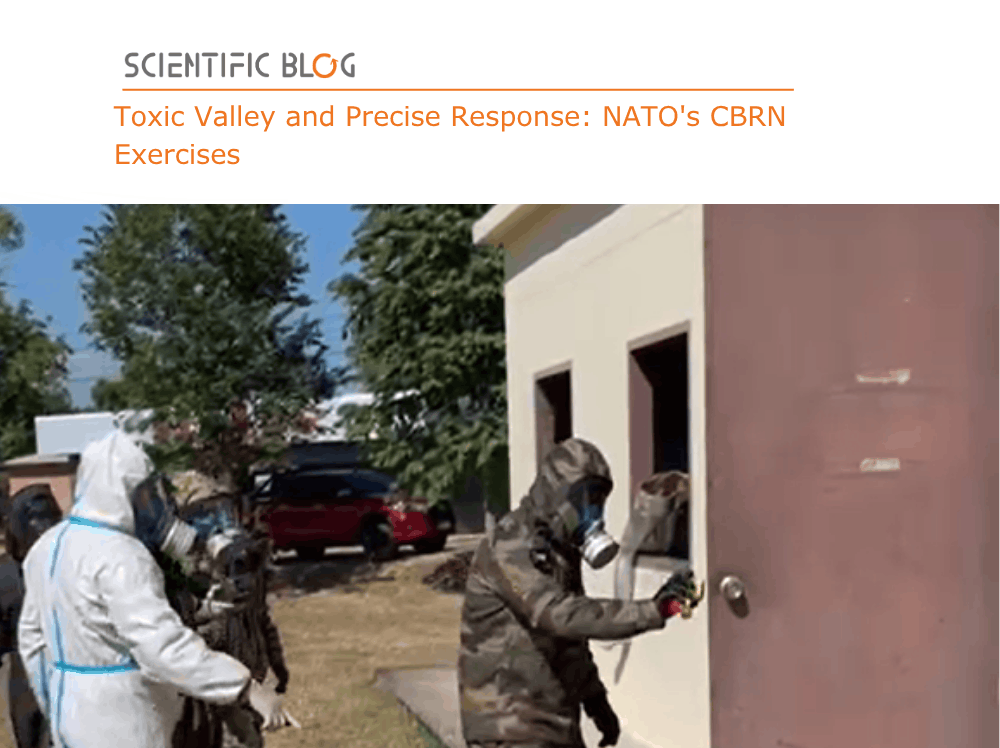
In Slovakia and Canada, two training grounds allow NATO’s CBRN specialists to work with real chemical warfare agents. Toxic Valley and Precise Response have become key annual fixtures.
1. The CBRN threat, a growing challenge for NATO
Chemical, biological, radiological and nuclear threats are constantly evolving and increasingly shape the conduct of operations. The proliferation of so-called unconventional weapons in recent years has been a reminder that these risks are very real.
To counter them, NATO relies on interoperability (harmonising technical specifications and operating procedures) and on sharing test and training facilities to raise the readiness of all Allied CBRN units. Joint training is the cornerstone of this effort. It gives forces the chance to practise in near-real-world situations and to learn to work together.
It also helps specialist units better advise staffs on integrating chemical defence into the planning and conduct of operations.
2. Two CBRN test centres, in Slovakia and Canada
Two annual events anchor this training. In Slovakia, Toxic Valley takes place at the Zemianske Kostoľany CBRN Training and Testing Centre, under the auspices of the Slovak Armed Forces. In Canada, Precise Response is held at Canadian Forces Base Suffield, Alberta, and organised by the Canadian Armed Forces in partnership with the government agency Defence Research and Development Canada (DRDC).
2.1. Toxic Valley
Located in a Slovak valley, the Zemianske Kostoľany facility is one of the few sites in the Alliance where multinational forces can routinely train in the open air with live chemical warfare agents. The exercise is aimed primarily at Sampling and Identification of Chemical Agents (SICA) teams and deployable laboratories. Sampling teams are evaluated against AEP-66, the NATO standard governing these procedures. NATO’s Joint CBRN Defence Centre of Excellence (JCBRN Defence COE) took part in the latest edition, in September 2026.
2.2. Precise Response
At Suffield, live agents are handled in dedicated facilities under very strict control. The exercise serves to validate the procedures, equipment and operational capabilities of participating units. It covers a broader spectrum than Toxic Valley, bringing in the explosive threat, decontamination assets and medical support, as well as the Task Force command element.
The medical component has grown in importance over the past four years. Doctors and nurses from several countries operate upstream of the decontamination line: they triage casualties, stabilise them and prepare them for evacuation, in an area where contamination remains a constant threat. They work alongside the Casualty Decontamination Module (CASDM), which decontaminates patients before medical evacuation. The aim is to strengthen the entire continuum of care, so that even frontline units can respond before heavier assets arrive. Medical staff work in full CBRN personal protective equipment: protective suits, masks, gloves and so on.
The aim is to strengthen the entire continuum of care, so that even frontline units can respond before heavier assets arrive.
3. Scenarios and missions
The principle remains the same from one edition to the next: immersing teams in realistic scenarios, alternating between live agents and simulants, to test their skills in conditions as close as possible to a real intervention.
Teams may be sent to a site that has just been attacked, where explosive devices, toxic substances and casualties are all present. They may also be tasked with identifying and analysing a clandestine chemical store, set up for example in a dimly lit, oxygen-depleted tunnel.
Participants work through reconnaissance of contaminated areas, detection, sampling, mobile laboratory analysis, neutralisation of explosive threats and decontamination. Sampling follows NATO protocols: every sample must remain secure and traceable so that it can be used as evidence in court.
These exercises require teams of different nationalities to coordinate, share their findings and apply common procedures. Their ability to act together without delay determines the effectiveness of the international response.
4. The French contribution: the 2nd Dragoon Regiment and the French Air and Space Force CBRN intervention section
In France, the 2nd Dragoon Regiment (2e RD), the French Army’s CBRN regiment, sends its specialists to both Toxic Valley and Precise Response every year, where French medical personnel also take part. Every four years, it also serves as the lead unit of the CBRN component of the NATO Response Force. In this role, it conducts certification and deployment exercises with its Allies, both in France and abroad.
The French Air and Space Force CBRN intervention section is also a long-standing participant in Precise Response, as well as in the Toxic Trip exercises, which focus specifically on CBRN issues at air bases.
5. Voices from CBRN officers
An officer from the 2e RD sums up the value of these exercises: “They often involve the use of real chemical or radiological agents, which makes for realistic, high-value operational scenarios.”
The Slovak Armed Forces, which host the exercise, stress that the threat is real and that their specialists train shoulder to shoulder with their foreign counterparts.
Finally, one phrase captures the spirit of these exercises: “A soldier’s gear isn’t always a rifle. Sometimes, it’s a gas mask, gloves and a protective suit.”
6. Frequently asked questions
What is the Toxic Valley CBRN exercise?
Toxic Valley is an annual CBRN exercise run by the Slovak Armed Forces at the Zemianske Kostoľany CBRN Training and Testing Centre. It is one of the few Alliance sites where multinational forces can routinely train in the open air with live chemical warfare agents. It is aimed primarily at Sampling and Identification of Chemical Agents (SICA) teams and deployable laboratories, which are evaluated against the NATO standard AEP-66.
Where does the Precise Response exercise take place?
Precise Response is held at Canadian Forces Base Suffield, Alberta. It is organised by the Canadian Armed Forces in partnership with Defence Research and Development Canada (DRDC). Live agents are handled in dedicated facilities under very strict control. The exercise covers a broader spectrum than Toxic Valley, including the explosive threat, decontamination assets, medical support and the Task Force command element.
Which French units take part in NATO CBRN exercises?
France sends specialists from the 2nd Dragoon Regiment, the French Army’s CBRN regiment, to both Toxic Valley and Precise Response every year, alongside French medical personnel. The French Air and Space Force CBRN intervention section is also a long-standing participant in Precise Response, as well as in the Toxic Trip exercises, which focus specifically on CBRN issues at air bases.
Why does NATO train with real chemical agents?
Using real chemical or radiological agents makes for realistic, high-value operational scenarios. By alternating between live agents and simulants, teams test their skills in conditions as close as possible to a real intervention. They also learn to coordinate across nationalities, share their findings and apply common procedures, an ability that determines the effectiveness of the international response.