



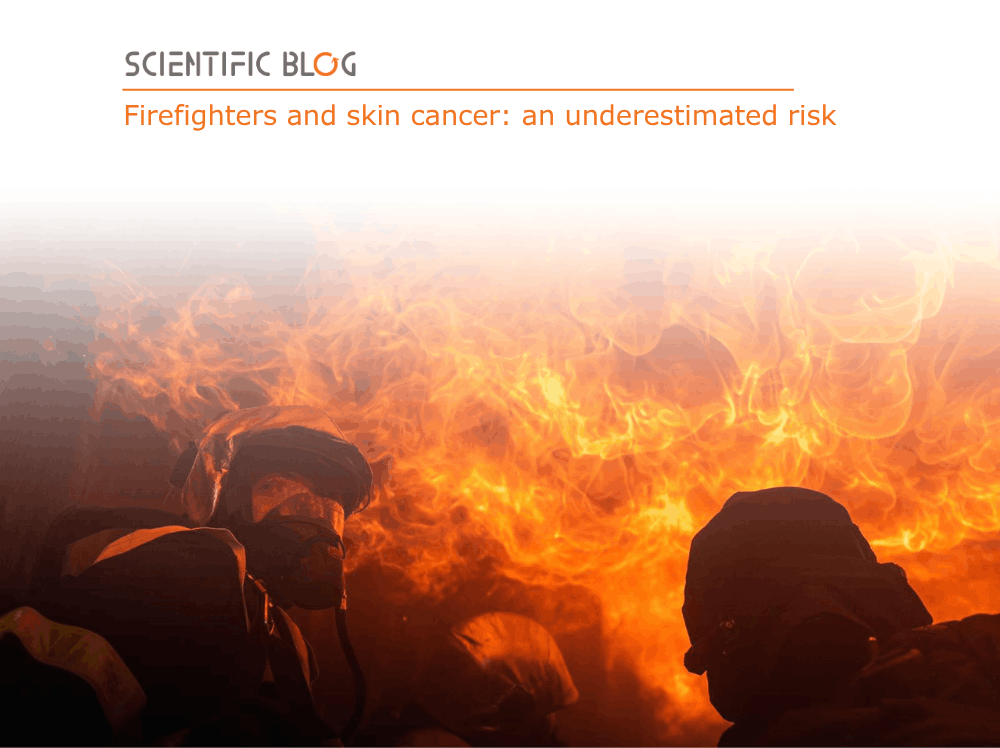
Firefighters are among the occupations most exposed to carcinogenic substances capable of affecting the skin. At every call, fire smoke and chemical compounds penetrate the body not only through the respiratory tract but also through the skin : a contamination pathway long overlooked in occupational risk prevention. Studies document a link between PAH exposure and increased melanoma rates. In response, Sulitec’s FIRESKIN® filtering base layer, built around an activated carbon medium, provides complementary dermal protection beyond what standard personal protective equipment offers.
1. A still underrecognized cutaneous exposure
The summer season is traditionally a time of heightened awareness around skin cancer and prevention campaigns. While solar exposure is the risk that most readily comes to mind, firefighters face a lesser-known but equally serious threat. Whether career professionals or volunteers, firefighters are among the occupations most exposed to carcinogenic substances capable of affecting the skin.
It is well established that chemical agents present in fire smoke are inhaled, but they also penetrate the body through the skin, often without firefighters’ knowledge. On every call, firefighters are exposed to a cloud of toxic compounds whose concentration and composition vary depending on the materials involved.
2. Dermal absorption, a silent contamination pathway
Skin-based contamination has long been underestimated in firefighter occupational risk prevention. Attention initially focused on the respiratory route, and significant progress was made with the development of self-contained breathing apparatus (SCBA).
However, during a fire, fine particles and chemical vapors settle on every part of the body where turnout gear comes into direct contact with the skin. These are precisely the areas where carcinogenic substances can be absorbed in significant amounts.
In 2022, the International Agency for Research on Cancer (IARC, Lyon), a WHO body, assessed the carcinogenicity of occupational exposure among firefighters and specifically highlighted the limitations of current PPE: secondary contamination of crew members who were not on scene by those returning from intervention, insufficient consideration of dermal absorption in turnout gear design, and the persistence of contaminants on equipment after use.
3. PAHs and PCBs: documented risks
Several large-scale studies have shown a link between firefighters’ regular exposure to PAHs (polycyclic aromatic hydrocarbons) — whose carcinogenic and mutagenic potential is well documented — and a significant increase in melanoma within this occupational group.
Firefighters are also more frequently affected by non-melanoma skin cancers (carcinomas) than the general population, largely due to frequent exposure to substances such as PCBs (polychlorinated biphenyls), volatile organic compounds released during fires involving aging electrical equipment, insulation, or building materials.
It is therefore essential to develop PPE that reduces contact with these substances.
4. FIRESKIN®: a filtering base layer
Sulitec has developed FIRESKIN®, a filtering base layer designed specifically to reduce firefighters’ dermal exposure to toxic substances.
Worn directly under turnout gear, FIRESKIN® is a one-piece garment that adds a filtering protective layer between the skin and the chemical environment of an intervention. It acts as an additional barrier against chemical vapors and toxic particles.
Its technology relies on a filtering medium made of activated carbon microbeads, known for their ability to adsorb volatile organic compounds and chemical vapors. The FIRESKIN® structure consists of three layers:
- skin-contact layer: soft, breathable cotton/polyester ripstop fabric,
- middle layer: activated carbon microbeads that filter toxic vapors,
- outer layer (in contact with protective clothing): 100% polyamide nonwoven fabric.
Its technical specifications are built for intensive operational use:
- a thickness under 0.8 mm to limit thermophysiological load when worn under firefighting gear,
- high air permeability (> 500 mm/s) for operator comfort,
- strong mechanical resistance,
- 24 hours of protection.
Made from a soft, thin, and durable fabric, and fitted with elasticated cuffs at the wrists and ankles, this ergonomic garment is comfortable to wear both during live interventions and live-fire training in Class A burn containers.
5. Rethinking protection beyond standard PPE
It’s worth remembering that skin cancer isn’t caused by sun exposure alone. It also affects anyone regularly exposed, through their work, to carcinogenic chemical substances that penetrate the skin barrier.
With FIRESKIN®, Sulitec offers a concrete, technological, and ergonomic solution to address the cancer risks — cutaneous or otherwise — faced by firefighters.
These risks are risks that standard PPE has so far failed to adequately address.
6. Frequently asked questions
Why are firefighters particularly at risk of skin cancer?
At every call, firefighters are exposed to a cloud of toxic compounds from fire smoke that penetrate the body not only through the respiratory tract but also through the skin. Carcinogenic substances — particularly PAHs and PCBs — settle on the parts of the body in direct contact with turnout gear and can cross the skin barrier, often without the firefighters’ knowledge. Studies have documented a significant increase in melanoma and carcinoma rates within this occupational group.
What chemical substances increase cancer risk in firefighters?
The main substances identified are PAHs (polycyclic aromatic hydrocarbons), whose carcinogenic and mutagenic potential is well documented, and PCBs (polychlorinated biphenyls), released during fires involving aging electrical equipment, insulation, or building materials. Large-scale studies have established a link between regular exposure to these compounds and a significant increase in both melanoma and non-melanoma skin cancers among firefighters.
What are the limitations of standard PPE in protecting firefighters’ skin?
In 2022, the IARC (WHO) highlighted several limitations of current personal protective equipment: dermal absorption is insufficiently considered in turnout gear design, contaminants persist on equipment after intervention, and secondary contamination affects crew members who were not on scene through contact with those returning from the field. While respiratory protection has improved considerably, the dermal exposure route remains inadequately addressed.
How does the FIRESKIN® filtering base layer work?
FIRESKIN® is a one-piece garment worn directly under turnout gear. Its middle layer of activated carbon microbeads adsorbs volatile organic compounds and chemical vapors before they reach the skin. At under 0.8 mm thick and with high air permeability, it provides 24 hours of protection while remaining comfortable during both live interventions and training. It acts as an additional barrier complementing standard PPE rather than replacing it.
Does FIRESKIN® replace standard firefighter PPE?
No, FIRESKIN® does not replace standard personal protective equipment — it complements it. Worn as a base layer under turnout gear, it adds an extra filtering barrier against chemical vapors and toxic particles. It is part of a broader approach to rethinking dermal protection for firefighters, addressing a gap that standard PPE has so far failed to adequately cover.