



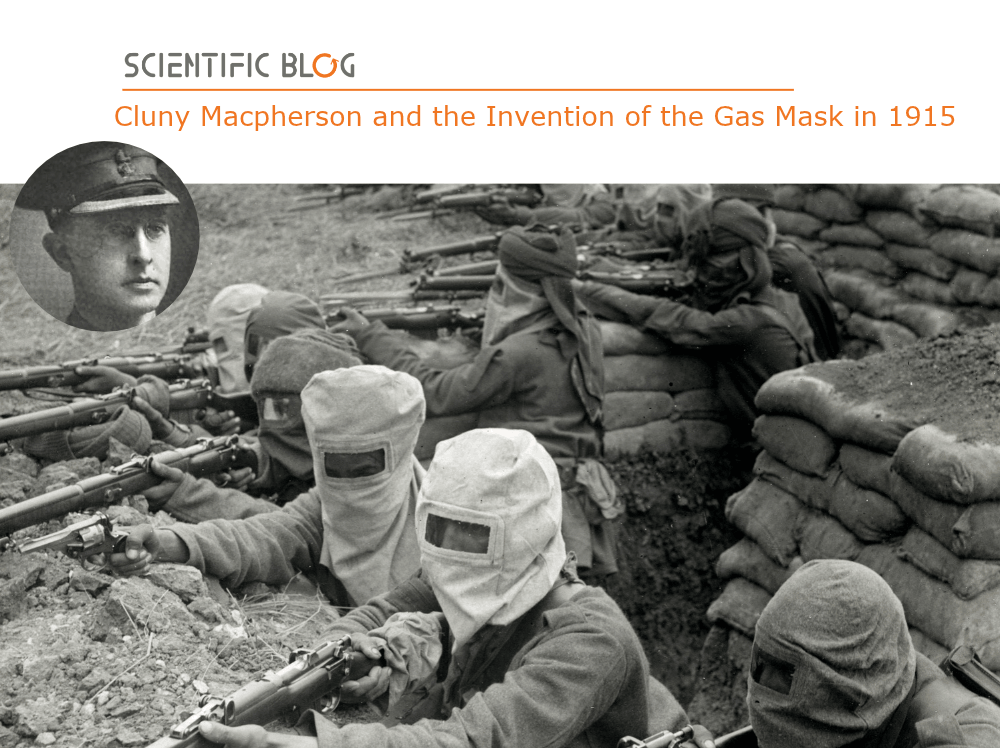
In this week of 11 November, when we commemorate the Armistice of 1918 and, more broadly, all those who “died for France” (Morts pour la France) in every modern conflict, we look back at the history of the very first gas masks used on the Western Front during the First World War.
In April 1915, near Ypres in Belgium, Allied soldiers watched a strange greenish cloud drifting towards them. The German army had just released some 160 tonnes of chlorine on the Western Front. No one had planned for any protection against it, and the effects were devastating: men choked and the lines fell into disarray. The general staffs had to act urgently: how could soldiers be kept breathing in poisoned air?
1. Breathing through a rag
In the first days, the means of defence were rudimentary. Some soldiers breathed through a cloth soaked in urine, whose ammonia partly neutralised the chlorine. From early May, the British issued cotton-wool pads wrapped in muslin. They then introduced the Black Veil Respirator: a cotton pad soaked in an absorbent solution and held over the mouth by a black veil. The device was fragile and hard to fit, and proved of little use against chlorine. It was in this context that Cluny Macpherson stepped in.
2. Cluny Macpherson’s hood
Born in 1879 on the island of Newfoundland, in what is now the Canadian province of Newfoundland and Labrador, Cluny Macpherson was a doctor in Labrador. When war broke out in 1914, he enlisted in the Newfoundland Regiment and became its principal medical officer. In 1915, he crossed the Atlantic with the regiment.
To improve on the Black Veil Respirator, Macpherson came up with a form of protection that would not be limited to the mouth and nose but would cover the whole head. The idea reportedly came to him when he saw a German soldier pull a bag over his head after a gas attack. The principle was simple: a khaki flannel hood measuring about 50 by 48 cm, impregnated with a mixture of glycerine and sodium thiosulphate, a chemical compound used in medicine as an antidote to cyanide and to neutralise chlorine. Photographers, who used it as a fixing agent, nicknamed it “hypo”, hence the mask’s later name. A rectangular window made of mica or cellulose acetate allowed the wearer to see. The soldier pulled the hood over his head and tucked the bottom into his tunic so that air could not get in underneath. He breathed directly through the treated fabric.
Macpherson presented his design to the War Office’s anti-gas department (the former British ministry of war) in May 1915. Prototypes were quickly produced, and the British army adopted the device as early as June under the official name of British Smoke Hood, or Hypo Helmet. All British troops were soon equipped with it, and Macpherson was appointed to the War Office committee responsible for protection against poison gas. By September 1915, some 2.5 million had been manufactured.
This first filtering device was far from perfect. The window broke easily and fogged up. In wet weather, the chemicals could run into the eyes. Many soldiers complained of headaches, probably caused by exhaled carbon dioxide building up inside the hood. But for the first time, British troops had genuinely effective protection against chlorine.
3. From hood to box respirator
Chemical warfare evolved quickly. The Germans introduced even more dangerous agents, such as phosgene, diphosgene and chloropicrin, and from 1916 gas shells became widespread on both sides of the front. Macpherson’s hood then served as the basis for new versions. The P (phenate) Helmet had two mica eyepieces and an exhalation valve connected to a tube held in the soldier’s mouth. The PH (phenate-hexamine) Helmet then incorporated more advanced absorbents to counter phosgene.
These hoods were eventually replaced by box respirators. The Small Box Respirator was issued at the front from 1916. This rubber mask with eyepieces included a small box of activated charcoal granules: air passed through the box first, then travelled up a tube to the mouth. Exhaled air was expelled through an exhalation valve. A clip closed the nose so that the wearer breathed only through the mouth.
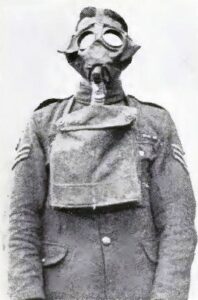
British soldier wearing the Small Box Respirator
This mask was also adopted by the American Expeditionary Forces. In the United States, the inventor Garrett A. Morgan had for his part patented a protective hood for firefighters in 1914, which drew more breathable air from near the ground and filtered smoke through a wet sponge. Ineffective against war gases, it was used only by civilians.
4. The French approach: the M2 mask and the ARS
The French army, for its part, also used pads soaked in sodium thiosulphate, along with separate goggles to protect the eyes, until the end of 1915. In 1916, it adopted the M2 mask, made of several layers of impregnated gauze covering the whole face, with built-in eyepieces. It had neither a valve nor a true filter. Protection depended on the thickness of the fabric and declined rapidly at high concentrations or with prolonged exposure. It was the result of collective work carried out in specialised laboratories. In France, it remained the standard mask until 1917–1918, when the Appareil respiratoire spécial (ARS, special respiratory apparatus) was introduced. This rubber mask was inspired by German masks in service since 1915, which had a filter canister screwed directly in front of the mouth.
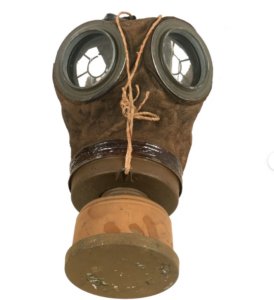
French Appareil respiratoire spécial
Armies would go on equipping themselves with masks, which would become part of a full protective suit. More than a century later, however, the basic principle remains the same: completely isolating the head from contaminated air.
5. Frequently asked questions
Who invented the first British military gas mask?
Britain’s first effective gas protection was designed by Cluny Macpherson, a doctor born in 1879 in Newfoundland and principal medical officer of the Newfoundland Regiment. He presented his hood design to the War Office in May 1915, a few weeks after the chlorine attack at Ypres. The British army adopted it in June 1915 under the name British Smoke Hood, or Hypo Helmet.
How did Macpherson’s gas hood work?
It was a khaki flannel hood measuring about 50 by 48 cm, impregnated with glycerine and sodium thiosulphate, a compound able to neutralise chlorine. A window made of mica or cellulose acetate allowed the soldier to see. He tucked the bottom of the hood into his tunic to keep outside air from getting in, and breathed directly through the treated fabric.
What were the problems with the first gas masks?
Macpherson’s hood had several weaknesses. Its window broke easily and fogged up, and in wet weather the chemicals could run into the soldiers’ eyes. Many men suffered from headaches, probably caused by exhaled carbon dioxide building up inside the hood. Even so, it was the first genuinely effective protection British troops had against chlorine gas.
What gas mask did the French army use in World War I?
Until the end of 1915, French soldiers relied on pads soaked in sodium thiosulphate and separate goggles. In 1916, they received the M2 mask, made of layers of impregnated gauze covering the whole face, with no valve or true filter. It was replaced in 1917–1918 by the Appareil respiratoire spécial (ARS), a rubber mask inspired by German models with a screw-on filter canister.
What was the Small Box Respirator?
The Small Box Respirator was a British box respirator issued at the front from 1916. This rubber mask with eyepieces contained a small box of activated charcoal granules that filtered the air before it travelled up a tube to the mouth. An exhalation valve expelled used air and a clip closed the nose. The American Expeditionary Forces also adopted it.