



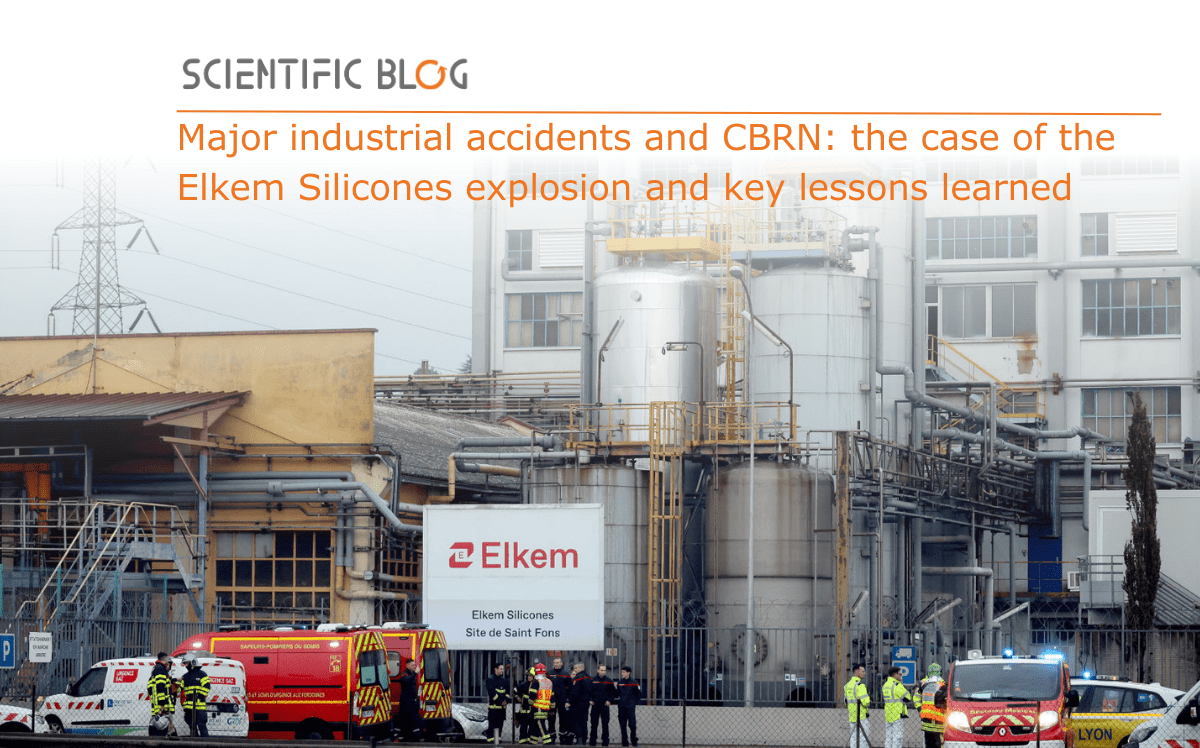
The explosion that occurred on 22 December at the Elkem Silicones industrial site in Saint-Fons, classified as a high-threshold Seveso site, is a stark reminder that major industrial accidents remain a very real threat. This event resulted in the death of two employees and left several others injured, highlighting the potential severity of this type of accident.
Beyond the industrial aspect, this accident illustrates the operational continuity between Seveso risks and CBRN scenarios, both in terms of the nature of the hazards and the emergency responses required. This article provides an in-depth analysis of the accident, its potential causes, crisis management, the role of first responders and key lessons learned in terms of CBRN protection, particularly with regard to personal protective equipment.
Presentation of the Elkem Silicones site and its industrial activity
Elkem Silicones, formerly Bluestar Silicones, is a major player in the production of silicones for many industrial sectors.
The Saint-Fons site, located in the heart of the chemical valley, is classified as a high-threshold Seveso site due to the quantities and hazardous nature of the chemicals handled there.
This classification imposes high requirements in terms of risk prevention, process control and emergency preparedness, particularly in laboratory areas where flammable gases and reactive substances are used.
Timeline and context of the 22 December explosion
Nature of the incident
The accident occurred in a laboratory/pilot workshop area of the site. An explosion occurred, followed by a fire. Initial technical analyses suggested the possible involvement of a flammable gas, in particular hydrogen, which is frequently used in certain chemical processes, although no definitive cause has been established at this stage.
Human and operational consequences
The explosion caused several injuries among employees, some of whom were seriously injured. Two victims died as a result of their injuries, bringing the human toll to two.
A major emergency response operation was immediately deployed. A security perimeter was set up around the site and nearby roads were temporarily closed. Sheltering measures were taken in the early hours, until it was confirmed that there was no residual danger to the population.
ORSEC plan and industrial crisis management
Activation and objectives of the ORSEC plan
In response to the accident, the ORSEC plan was activated to coordinate all those involved in crisis management.
Its objectives are to:
- protect the population,
- organise and secure rescue operations,
- control the effects of the accident,
- ensure clear and appropriate communication.
Seveso risks and link to CBRN threats
Why an industrial accident falls within the scope of CBRN
Even in the absence of malicious intent, a major industrial accident can produce effects similar to a CBRN scenario: chemical dispersion, mass exposure, the need for respiratory protection, temporary containment and decontamination.
Continuity between industrial safety and CBRN doctrine
The management of these events is based on common principles:
- anticipation and preparation,
- individual and collective protection,
- contamination control,
- resilience of territories.
First responders’ intervention in a major industrial accident
The role of firefighters
Firefighters are the backbone of the operational response. Their mission is to:
- recognise the nature of the danger,
- secure the area,
- rescue victims,
- control the fire,
- prevent the situation from worsening.
In a Seveso context, the intervention is carried out under conditions of chemical uncertainty, requiring quick and cautious decisions.
Risks faced by first responders
First responders are exposed to:
- toxic or oxygen-depleted atmospheres
- chemical splashes,
- thermal hazards,
- secondary contamination.
Protecting responders therefore becomes a major factor in the success of the operation.
Essential PPE in industrial CBRN contexts
Respiratory protection
The use of appropriate respiratory equipment is essential to prevent the inhalation of hazardous substances, whether specific filters or self-contained breathing apparatus.
The OUVRY OC50® mask, combined with the CFO® CBR Spectre Large canister, offers effective protection against toxic gases, chemical vapours and hazardous aerosols that may be present during a Seveso accident, while ensuring excellent ergonomics for responders.
Body protection
Protective suits, gloves and overboots must provide an effective barrier against chemical agents, while allowing for mobility and operational endurance. For example, the OUVRY POLYCOMBI® is an overall protection suitable for industrial CBRN environments.
OUVRY’s expertise at the service of responders
The solutions developed by OUVRY meet the highest CBRN requirements. Designed for extreme environments, they provide effective protection for firefighters and other first responders against industrial chemical hazards, while ensuring ergonomics, reliability and operational compatibility.
Feedback: the major accident at Bluestar Silicones in 2016
Recap of the 2016 event
In 2016, the site then operated by Bluestar Silicones had already experienced a major industrial accident, leaving a lasting mark on the collective memory and highlighting the potential danger of these facilities.
Comparison between 2016 and 2025
The two events show similarities in terms of industrial risks, but also notable differences in crisis management, communication and consideration for the safety of those involved.
Key lessons
These successive accidents highlight the importance of:
- a stronger safety culture,
- continuous training,
- equipping responders with appropriate PPE,
- and the full integration of CBRN principles into industrial management.
Overall lessons for industrial risk management
The Elkem Silicones explosion illustrates the need for a comprehensive approach to industrial safety, integrating prevention, preparedness, response and feedback. The protection of workers and emergency responders cannot be separated from CBRN risk management.
Conclusion
The accident in Saint-Fons is not just a minor industrial incident. It is a stark reminder of the challenges associated with Seveso sites and the management of major chemical risks. The operational response, the protection of firefighters and the use of appropriate CBRN PPE are key elements in limiting the human and environmental consequences.
In a complex industrial context, CBRN preparedness remains an essential pillar of resilience and collective security.
Bibliography
- Communiqué officiel de la préfecture du Rhône – Site de l’État
- Alerte et actions des secours – FR-Alert et levée du confinement – The Local
- Explosion et incendie avec contexte hydrogène et reprise des circulations – Euronews
- Explosion à une usine chimique près de Lyon (contexte Seveso) – The Connexion
- Explosion : un blessé décédé (premier bilan) – Le Monde