



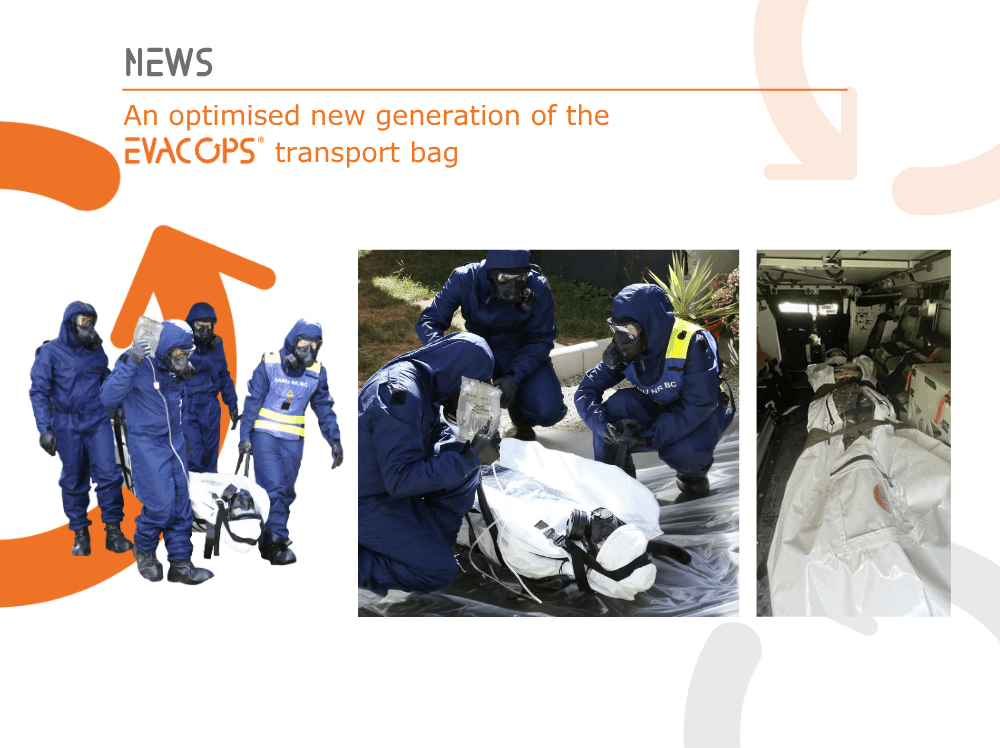
The EVACOPS® evacuation bag enables the extraction and transport of contaminated casualties without causing secondary contamination. Developed in response to requirements issued by the French Special Operations Command (COS) in 2014, it was validated by the École du Val-de-Grâce in 2019 and awarded the Milipol Innovation Prize that same year. The bag provides CBRN protection for up to 48 hours, combining containment technology with DECPOL® hyper-absorbent pre-decontamination and activated carbon filtration, while maintaining continuity of care through dedicated medical access points. A new generation integrates field feedback from special forces, university hospitals, and fire services.
1. A device rooted in field expertise and CBRN research
The EVACOPS® evacuation bag leverages OUVRY’s expertise in CBRN protection systems and its research into innovative filtering and absorbent materials. It was developed to meet requirements issued by the COS (French Special Operations Command) in 2014 for the transport of contaminated casualties without causing secondary contamination.
The device’s effectiveness was validated in 2019 by the École du Val-de-Grâce through an internal research thesis as part of a CBRN Master’s degree. This academic validation has since led to numerous conferences and publications both in France and internationally. Furthermore, EVACOPS® was awarded the Milipol Innovation Prize in 2019.

2. A unique solution addressing two CBRN operational concepts
During a CBRN incident, first responders must balance two imperatives: ensuring decontamination and providing care to casualties in “absolute emergency” status. The EVACOPS® evacuation bag enables the extraction of casualties who cannot be decontaminated on-site, allowing their transport to hospital facilities without contaminating medical staff, equipment, evacuation assets (ambulances, helicopters, etc.), or premises, all while maintaining continuity of medical procedures.
In a different context, such as a military theatre of operations, the EVACOPS® bag can conversely be used to protect a non-contaminated casualty — who may be unable to don CBRN personal protective equipment — within a toxic environment.
3. Containment technology enabling continuity of care
The EVACOPS® bag provides CBRN protection for up to 48 hours.
3.1. Key technical specifications
- External sealing: the outer material is impermeable to CBRN agents in both liquid and vapour forms.
- Casualty pre-decontamination: inside the bag, a hyper-absorbent material utilising DECPOL® technology traps liquids, while a filter media based on activated carbon microbeads adsorbs toxic vapours.
- Facilitated medical access: equipped with two longitudinal zips, two cable ports for medical devices, and a large monitoring window.
The device features ten handles for ease of transport. The external surfaces can be decontaminated using appropriate wipes, such as DECPOL ABS® or DECPOL RAD®.
4. An optimised new generation based on field feedback
Following a logic of continuous improvement, OUVRY has upgraded the first-generation EVACOPS® bags based on feedback from end-users, including special forces, university hospitals, and fire services.
- The distribution of absorbent and adsorbent materials inside the bag has been redesigned to better meet pre-decontamination requirements.
- On the outer shell, strap attachments have been reinforced for greater durability during handling and transport.
- The ergonomics of the head support integrated into the hood have been improved. The design of the butyl rubber neck seal has been adjusted to fit all morphologies and accommodate a cervical collar. A surgical cap has also been integrated to clear hair away, facilitating access to the ENT area.
5. An innovative operational alternative
The EVACOPS® evacuation bag offers an alternative to “sarcophagus-type” devices by combining several essential functions:
- Containment and protection of medical staff and logistical assets.
- Pre-decontamination of the casualty.
- Access to the patient and continuity of care.
- Reduced weight and bulk.
- Low logistical footprint (no maintenance or batteries required).
6. Frequently asked questions
What is the EVACOPS® evacuation bag used for?
The EVACOPS® bag is designed to transport CBRN-contaminated casualties without causing secondary contamination to medical staff, equipment, or evacuation vehicles. It simultaneously maintains continuity of care through integrated medical access points, and can also be used to protect a non-contaminated casualty within a toxic environment where CBRN personal protective equipment cannot be donned.
How long does the EVACOPS® bag provide CBRN protection?
The EVACOPS® bag provides CBRN protection for up to 48 hours. Its containment technology combines a DECPOL® hyper-absorbent material that traps liquid agents and an activated carbon microbead filter media that adsorbs toxic vapours, while the outer shell remains impermeable to CBRN agents in both liquid and vapour forms.
How was the EVACOPS® bag scientifically validated?
The effectiveness of EVACOPS® was validated in 2019 by the École du Val-de-Grâce through an internal research thesis completed as part of a CBRN Master’s degree. This academic validation led to numerous conferences and publications in France and internationally, and the device was awarded the Milipol Innovation Prize in 2019.
What improvements does the new generation EVACOPS® bring?
The new generation integrates feedback from special forces, university hospitals, and fire services. Improvements include redesigned internal distribution of absorbent and adsorbent materials, reinforced strap attachments on the outer shell, improved head support ergonomics, a butyl rubber neck seal adapted to all morphologies and cervical collars, and an integrated surgical cap to facilitate access to the ENT area.
How does EVACOPS® differ from sarcophagus-type devices?
Unlike conventional sarcophagus-type devices, EVACOPS® combines containment, pre-decontamination, medical access, and continuity of care in a single lightweight and compact piece of equipment. It requires no maintenance or batteries, providing a low logistical footprint particularly suited to operations in demanding environments.